





The Wild West of Compute: US midterm backlash triggers fierce battle over local AI data centre moratorium
The geopolitical fault lines shifting beneath Canberra owed their sudden alignment to a historic electoral earthquake across the Pacific. The global political landscape has fractured following the comprehensive defeat of Donald Trump’s Republican Party in the November 2026 US midterm elections. In a sweeping rebuke, American voters stripped the GOP of its majorities, handing control of both the House of Representatives and the Senate to the Democrats.
For the White House, the verdict is a catastrophic domestic paralysis, rendering President Trump a "lame duck" for his final two years in office. But for Anthony Albanese it is the opportunity to re-evaluate his own fractured domestic agenda to avoid a similar voter backlash.
Yet despite the unprecedented drop in voter confidence - four out of every five voters - and the cost-of-living crisis, characterised by sticky inflation and a punishing cash rate, the Albanese is is making excuses for a sore point with voters: AI data centres.
There is little doubt that the dramatic voter revolt against artificial intelligence infrastructure in the United States has ignited a fierce political battle in Australia, weaponising local community anxiety and forcing a tense standoff over a proposed nationwide moratorium on new data centres.
“If the Albanese Government takes any message from the US midterms lasts week: it should be that we need a pause on the AI data centre rush, said Senator Sarah Hanson-Young, Greens environment and communications spokesperson.
“The Government should heed the warning from the United States and put in place an immediate moratorium on data centre approvals.
“People all over Australia are telling our government that we don't want these massive, US based AI mining companies setting up shop in our suburbs.
“Australians are clear: we say no to building data centres near people's homes, schools, hospitals, workplaces, or on prime agricultural land, especially whilst they leave us with higher living costs, mortgages, less jobs, and more pollution.”
Yet Prime Minister Anthony Albanese's announcement yesterday on new artificial intelligence safety protections and the establishment of a new artificial intelligence safety regulator, following a major cyber security breach targeting government websites, is nothing more than an attempt to conceal total capitulation to vampire AI corporations.
This toothless regulator is the result of a Prime Minister Office managed agenda and a Labor controlled committee process that gave another predictable acquiescence to big tech.
The recommendations maintain Labor’s plan for a massive national roll out of US data centres. They don’t include a single new legal power to curb the behaviour of these extractive corporations as they pertain to community consultation, environment, energy consumption, water consumption or copyright.

11 November 2026
ALAN HAYES
WITH hundreds of multi-billion-dollar computing facilities either under construction or filling the regulatory pipeline nationwide, a broad coalition of community groups, environmental advocates, and crossbench politicians is demanding an immediate freeze on approvals. They argue that without urgent intervention, the rapid expansion of these energy-hungry, water-guzzling "behemoths" will permanently compromise suburban residential areas, strain the domestic electricity grid, and exhaust vital community resources.
Unsurprisingly, the Australian Greens have quickly seized on the American momentum to lead calls for a comprehensive, nationwide freeze on all new data centre permits. The minor party argues that Australia has quietly become a "regulatory safe haven" for Silicon Valley giants fleeing tightening conditions in North America and Europe.
“What we saw in the United States last week was a clear message from everyday people who are fed up with having their water, their power, and their neighbourhoods stolen by unchecked AI expansion,” said the Greens' environment and communications spokesperson, Sarah Hanson-Young. “Australia cannot continue to operate as the 'wild west' of global compute. We need a timeout. We must pause all new approvals until we have robust, federally mandated regulations that put the long-term liveability of our communities ahead of the server requirements of foreign technology corporations.”
The Greens are preparing a private senator’s bill to enforce a temporary halt on state and federal planning approvals for facilities exceeding 15 megawatts. The proposed legislation aims to strip multi-billion-dollar projects of their "State Significant Development" status—a fast-track planning pathway that critics argue routinely bypasses municipal councils and leaves local residents entirely in the dark.
Suburban warfare
The AI debate has already translated into open community warfare in the suburbs of Sydney and Melbourne, where grassroots resistance groups are claiming major victories against industrial developers.
Just recently, plans for a controversial multi-billion-dollar AI data centre hub proposed for the Cooks River precinct at Arncliffe, in Sydney’s south, were abruptly scrapped following a relentless community campaign. Developers Stockland and John Boyd Properties withdrew the data centre component of their 18.3-hectare logistics project after the Stop the Cooks River AI Project (SCRAP) mobilised hundreds of residents over threats to local water systems, energy supply, and endangered urban wildlife species.
“This is a monumental victory for people power,” said a SCRAP spokesperson. “But a win in Arncliffe doesn't fix the systemic problem. We are seeing these giant warehouses pop up like mushrooms all over our cities, hidden behind opaque planning laws. We need a blanket ban until the rules are rewritten.”
The focus of community outrage has now shifted to Western Sydney, where residents in Merrylands and Guildford are actively rallying against the Goodman Group’s $1.1 billion Project Pluto Data Centre. Approved silently in July under state-significant planning pathways, the massive 126-megawatt facility is slated to operate 24 hours a day, seven days a week. Crucially, the site sits just 20 metres from the Guildford West Sports Ground and a mere 145 metres from local family homes.
“Nobody asked us if we wanted a 126-megawatt humming monster right next to where our kids play football,” said a local resident organising a petition against Project Pluto. “The system is fundamentally broken. It is entirely biased toward large data corporations and treats everyday people like an afterthought.”
And the Central Coast of NSW? We are not immuned from the Chris Minns surreptitiousness under the guise of a state significant development. The 'behemoth' planned for Wyong on the edge of Porter Creek Wetlands, and in close proximity to suburban homes, would have devastating impact on the area, and poses a danger to the Central Coasts's major water supply district. A Behemoth for the Central Coast and Fast-tracked 'AI Factory' sparks outcry exposed the true nature of the Minns Government strategy.
Heavy regulation, no ban
The Albanese Labor Government has explicitly rejected the crossbench demand for a blanket moratorium, labelling a total freeze as an economically reckless move that would cripple Australia’s digital economy and jeopardise thousands of future tech sector jobs. Which are??????
Instead, the federal government is attempting to chart a middle path: a dramatic, aggressive tightening of regulatory frameworks designed to force data centre operators to pay their own way and respect local boundaries.
The government confirmed that upcoming federal data centre guidelines—which have been fast-tracked following the US election results—will be finalised late this year or early next year. The centre piece of the new code will be a strict, non-negotiable ban preventing any new hyper-scale data centres from being built inside or directly adjacent to established residential suburbs.
Furthermore, the code will introduce a strict "Resource Accountability" mandate. To ease the mounting pressure on domestic utilities, future data centre developers will be legally barred from drawing directly from community water infrastructure or the standard residential electricity grid. Instead, operators will be required to invest in and construct independent power microgrids, secure private water recycling plants, or heavily subsidise localised green-energy infrastructure.
Crucially, federal ministers have hinted that the new regulatory framework may include retroactive "veto clauses." These would allow state planning ministers to reassess, alter, or completely revoke planning approvals for controversial projects—such as Project Pluto—if developers fail to prove they have secured a genuine "social licence" from their host communities.
“We understand the deep anxiety being felt by communities in Western Sydney and across the country,” a government spokesperson stated. “But the answer is not to shut the door on billions of dollars in infrastructure investment and send Australia into a digital dark age. The answer is ironclad, unyielding regulation. If tech companies want to build in Australia, they must do so on our terms, using their own resources, and keeping well away from our suburbs.”
Infrastructure pushed to breaking point
While the political standoff intensifies over a national computing freeze, the frontline of Australia's data centre expansion, which recently shifted to the Central Coast, has a localised infrastructure crisis rapidly unfolding.
Coasties live in a region defined by its pristine natural resources and quiet residential suburbs, and communities across Wyong and Warnervale are warning that unchecked hyper-scale developments are pushing essential local systems toward an environmental breaking point.
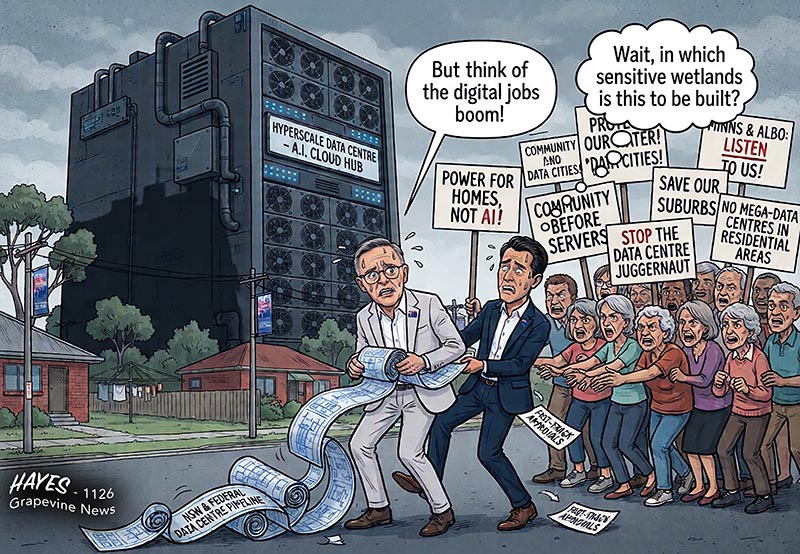
The central focus of this community battle is the escalating threat to the Wyong Valleys water catchment district, the primary water supply source for the entire Central Coast region, and the critical threat on the Porters Creek Wetlands, the largest freshwater wetland system on the Central Coast. Acting as a crucial 50-square-kilometre natural filter, this highly sensitive ecosystem purifies water runoff directly feeding into the Wyong River and the broader Tuggerah Lakes estuary.
Environmental groups and residents warn that inserting heavy digital infrastructure directly into the region's critical catchment, compromises a fragile water network already under long-term stress. Because a single hyper-scale data hub demands millions of litres of water daily for its evaporative cooling towers, local emergency reserves face rapid depletion: data centre proponents are actively moving to capture water entitlements originally allocated for agriculture.
Specifically, corporate developers are aggressively seeking out and attempting to purchase water licenses from local turf farms operating near the Wyong River and Jilliby Creek. Historically utilised for localised irrigation, these primary industry licenses are being aggressively targeted to fulfill the dense, industrial cooling demands of 24/7 server arrays. Critics argue that allowing tech giants to consume regional agricultural water rights bypasses domestic protections and establishes a dangerous precedent, essentially privatising a shared public resource and placing the tech pipeline directly ahead of the Central Coast's long-term drinking water security.
Local environmental groups also allege that heavy industrial data hubs, which rely on massive cooling towers, risk severely depleting the regional water table while introducing thermal pollution risks into a vital municipal catchment district.
Compounding the community backlash is an escalating battle over severe acoustic disturbances. Unlike standard manufacturing hubs, data centres operate on a relentless 24-hour cycle, producing a continuous low-frequency drone from thousands of heavy-duty industrial cooling fans and massive emergency backup diesel generators. In areas where developers have positioned facilities adjacent to growing residential zones, family neighbourhoods are reporting unprecedented levels of noise pollution. Local action groups argue that the constant vibration is shattering the peaceful liveability of regional suburbs, triggering sleep disruption and sparking immediate health concerns among nearby households.
Hovering over these local environmental threats is a regional electricity grid that is fundamentally unable to cope. Power infrastructure planners confirm that the rapid introduction of data centres—many demanding upwards of 100 megawatts apiece—will place an unsustainable burden on the Central Coast's aging power distribution systems.
With regional demand spiking far beyond historical forecasts, energy experts warn that residential users face the dual threat of soaring electricity prices and a highly vulnerable grid, increasingly prone to rolling brownouts during peak summer heatwaves. As the NSW Labor government continues to utilise fast-track approval channels to accommodate multinational tech firms, Central Coast residents feel increasingly sidelined. The brewing local crisis has laid bare a stark reality: without immediate, comprehensive intervention, the region's natural environment and basic public utilities are being traded away to power the global cloud.
A fragmented planning system exposed
The ongoing AI debate has exposed deep structural flaws within Australia's state-level planning regimes. In early November, a comprehensive parliamentary inquiry in New South Wales handed down its findings on the state's digital infrastructure boom.
The cross-party committee’s report offered a damning assessment of the status quo, explicitly concluding that the current planning system completely failed to assess the cumulative, long-term strain that clusters of massive data centres place on local power grids and municipal water supplies. The report noted that while individual facilities might pass environmental assessments on paper, the combined impact of multiple 100-plus megawatt operations within a single local government area was pushing suburban infrastructure to its absolute limit.
Despite the highly critical findings, the committee ultimately stopped short of recommending a full, legally binding moratorium—a compromise that drew sharp, public condemnation from the inquiry’s own chairperson, who accused the committee of buckling under intense pressure from powerful corporate technology lobbies.
Greens Leader Senator David Shoebridge said "Australians are demanding a moratorium on new AI data centres and all Labor gave us all yesterday (in his announcement) is a word salad instead.
“This review is Albanese all over, messaging over substance and pretend reform in a desperate attempt to paper over his total surrender to US demands.
“The Prime Minister had the gall to announce another regulator without the powers and protections needed to hold these corporations to account.
“It’s utterly bizarre that just weeks after OpenAI was implicated in hacking a Medicare portal the Government’s key recommendation is to get closer to OpenAI.
“Sending public servants on secondment to the companies they’re meant to regulate is how regulators get captured. When those companies are vampire US AI companies the risks of this strategy are obvious.
“AI data centres are sucking power out of the grid pushing power prices up for all of us, sucking construction workers out of the housing build and driving inflation, stealing artists' work, and Labor announces another toothless, powerless regulator with no new legal powers to stop them.
“Being a world leader in AI doesn’t mean being a doormat to big tech. It means being prepared to regulate it, to protect Australians and to make sure corporate profits don’t come at the expense of everyone else.”
With community protests scaling up and the federal opposition preparing to use the issue as a key battleground heading into the next election, the pressure on the Albanese government is mounting. And, as the final text of the upcoming federal guidelines is hammered out behind closed doors, Australia sits at a critical crossroads: attempting to secure its place in the global artificial intelligence economy while trying to prevent an American-style grassroots political revolt in its own suburban backyards.






SUBSCRIBE FOR FREE to the Grapevine News Online and to the monthly e-book edition of the Grapevine Community Weekly. Our online news platform and monthly newspaper is about real local news and events. We will not spam you or share your details with third parties.
