



State government exposed
for burying mental health shortfalls
The Minns Labor government has been accused by the Greens and healthcare advocates of intentionally concealing a massive funding crisis in the state’s public mental health sector. Hundreds of internal NSW Health documents, forced into the public light via a contested upper house parliamentary order, show that senior bureaucrats explicitly warned Mental Health Minister Rose Jackson that publishing the full extent of the system's shortfalls would cause severe "reputational damage" unless accompanied by an immediate, massive injection of taxpayer funds.
21 October 2026
ALAN HAYES
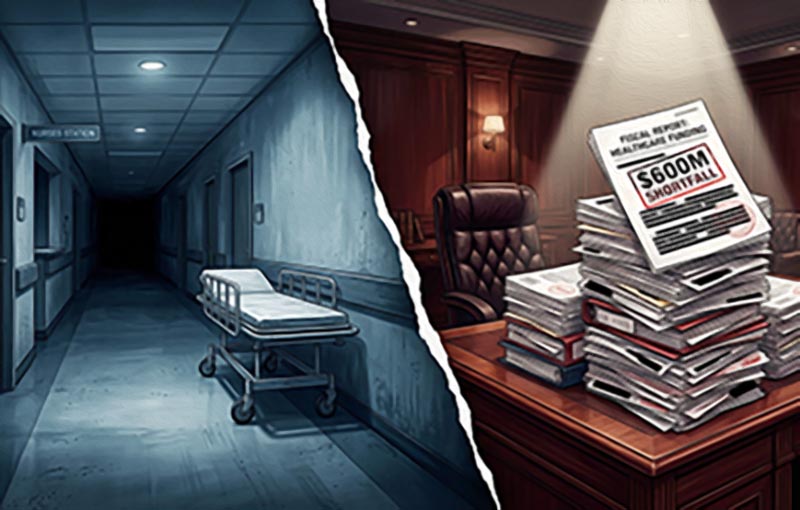
THE Minns government is facing a bruising political crisis following revelations that it intentionally withheld a damning report exposing a $600 million annual funding black hole in New South Wales’ public mental health system.
The disclosure of the damning 'black hole' report has ignited a firestorm across the state's political landscape. Healthcare advocates, frontline workers, and crossbench MPs accuse the government of prioritising political damage control over transparent governance and the welfare of vulnerable citizens.
At the heart of the controversy is a highly sensitive "gaps analysis" report compiled by NSW Health. The internal ministerial briefings reveal a public mental health apparatus that is structurally starved of resources and buckling under unprecedented demand.
According to the unredacted documents, NSW Health calculated that an additional $550 million to $600 million per year is required just to fund the baseline roster of frontline public mental health clinicians, nurses, and support staff needed to meet current patient volumes.
Furthermore, the analysis concluded that a one-off capital infrastructure investment exceeding $700 million is urgently required to expand physical facilities, psychiatric wards, and community health hubs capable of housing this expanded workforce.
Internal correspondence between health executives laid bare the stark reality of the crisis. In several email chains, officials acknowledged that to truly eliminate unmet demand and halt a catastrophic wave of resignations among burning-out clinicians, the state’s overall mental health budget would effectively need to be doubled.
The paper trail of suppression
The timeline of the report's handling has drawn the sharpest condemnation from political opponents. The Greens, who spearheaded the parliamentary order to compel the production of the documents, reveal that the comprehensive gaps analysis was finalised and sitting on Minister Rose Jackson’s desk well over a year ago.
Greens MP and health spokesperson Dr Amanda Cohn stated that the Minns administration effectively "sat on this report for at least 18 months." Rather than publishing the findings to foster an open public debate about healthcare reform, the government opted for a strategy of containment.
“The Minns Labor government was clearly told how poorly mental health care is funded in NSW. Instead of fixing the problem, they tried to bury it.” Dr Cohn said.
“People who need mental health care are waiting for days, not hours, in emergency departments, or are putting off their next appointment because they can’t afford it. They deserve more than spin from the NSW government.”
Internal memos show NSW Health advising the Minister's office against an open release, explicitly citing the risk of negative media coverage and public erosion of trust. Following months of internal debate, the government eventually opted to publish a heavily watered-down, de-identified version of the data. To minimise public scrutiny, this sanitised report was quietly uploaded to a departmental website late on a Friday afternoon.
"This wasn't an oversight; it was a deliberate cover-up," Dr Cohn argued. "The government knew the system was collapsing, they knew exactly how much money it would take to fix it, and instead of acting, they hid the truth to protect their own political skin."
Another brief shows the gaps analysis report was prepared for release in February 2025. It was then revised following a meeting with the Minister, and to be ‘published on instruction by the Minister’s office’. A shorter version was finally released last month with local health districts de-identified.
“The Minns Labor government made a commitment before it was elected to do this analysis and to be transparent with the community. Instead, they sat on this report for at least 18 months, before quietly releasing it on a Friday afternoon with data too vague to be meaningful or helpful,” Dr Cohn said.
Backlash from the frontlines
For those working within the NSW public hospital network, the revelations confirm what they have experienced for years. Frontline psychiatrists, psychiatric nurses, and emergency department staff have long warned that acute mental health units are operating at breaking point.
The New South Wales Nurses and Midwives’ Association (NSWNMA) and various medical unions responded to the leak with a mix of fury and validation. Union representatives pointed out that the $600 million shortfall directly correlates with chronic understaffing, extreme burnout, and an exodus of qualified professionals fleeing to the private sector or leaving the healthcare industry altogether.
Advocates point out that the human cost of this underfunding is felt daily in emergency departments across Sydney and regional NSW, where patients experiencing acute psychiatric crises are routinely subjected to "ED boarding"—waiting days in loud, chaotic emergency wards for an available psychiatric bed.
Minns defends record; rules out tax hikes
Facing intense questioning, Premier Chris Minns refused to back down, mounting a pragmatic defence of his government's fiscal management while acknowledging the severity of the challenge.
In a candid press conference, Premier Minns did not contest the validity of the leaked figures. In fact, he went further, admitting that when factoring in inflation and escalating post-pandemic demand, the true structural shortfall in the mental health sector is likely significantly higher than $600 million.
However, Minns forcefully rejected the characterisation that his government had abandoned the sector. He emphasised that since winning office, the Labor administration has boosted the state's mental health budget by 20 per cent—an increase he characterised as historic given the severe fiscal constraints inherited from the previous Coalition government.
"The reality of governing is making incredibly difficult choices with a finite pool of money," Minns told reporters. "We have put a fifth more funding into this portfolio since taking office. But there is only so much money we can invest across transport, education, housing, and healthcare simultaneously."
Crucially, the Premier closed the door on any emergency funding mechanisms that would require altering the state's revenue base, explicitly ruling out tax increases to bridge the $600 million gap. "I am not prepared to increase the tax burden on the families of this state to cover the entirety of this shortfall," Minns stated.
Political fallout and the road ahead
The Premier's admission has done little to quiet the growing political storm. The state opposition has seized on the scandal, framing it as a symptom of a government that values optics over substance.
With a minority position in the upper house, the Minns government remains highly vulnerable to crossbench pressure. The Greens and minor parties are already signalling that they will use the upcoming budgetary sessions to demand structural changes to health allocations, using the unredacted figures as leverage.
As the dust settles on the leaked documents, the focus shifts from political accountability to systemic survival. With the government ruling out new revenue and frontline services facing a certified half-billion-dollar deficit, clinicians warn that without an unexpected intervention, the state's mental health crisis will continue to deepen behind closed doors.






SUBSCRIBE FOR FREE to the Grapevine News Online and to the monthly e-book edition of the Grapevine Community Weekly. Our online news platform and monthly newspaper is about real local news and events. We will not spam you or share your details with third parties.
