





Grim economic plan
While the federal government promotes a tech-led economic roadmap, critics argue that the rapid rollout of hyperscale data centres carries hidden costs that outweigh the localised economic benefits.
The escalating friction surrounding Australia’s digital infrastructure boom has intensified the debate over the environmental and economic trade-offs of the nation’s artificial intelligence roadmap. As community resistance, infrastructure shortfalls, and legislative proposals converge, the federal government's tech-focused strategy faces mounting pushback.
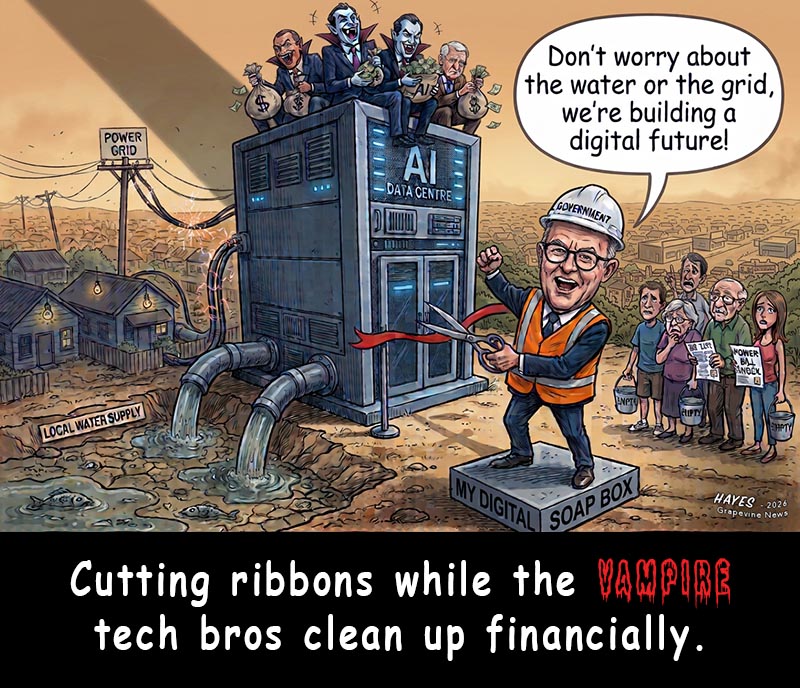
Critics warn that Australia's aggressive pivot toward an artificial intelligence-driven economic plan risks straining public infrastructure and compromising national sovereignty to benefit foreign vampire tech conglomerates.
28 October 2026
ALAN HAYES
WORSENING economic conditions from the government's visionless plan to our economic future to vampire US tech bros is not the answer according to Australian Greens Leader Senator David Shoebridge. The Greens, and other minor crossbenchers, assessment was in response to the Treasurer’s announcement that the economy will be focused on these vampire US tech bros, with no answers to soaring corporate profits, untaxed resource exports or the resulting inequality.
The primary concern centres on the staggering power demands of AI computing. Unlike traditional cloud data centres, training advanced AI models requires massive, uninterrupted electrical currents. Energy analysts warn that this surge in demand arrives at a volatile time for the National Electricity Market (NEM), which is currently transitioning away from legacy fossil fuels.
Because renewable energy generation and battery storage infrastructure are not scaling fast enough to match the tech sector's appetite, the grid is increasingly forced to rely on aging coal-fired power stations and gas-fired peaker plants to maintain baseline grid stability. Climate advocates point out that keeping these polluting assets online longer, directly contradicts Australia's emissions reduction targets. Furthermore, the sheer volume of power consumed by these facilities risks driving up network costs, a financial burden that is ultimately passed down to everyday consumers through higher retail electricity bills.
The Treasurer’s warnings last week about a bleak future show the growing economic divide in our country - where corporate profits are surging, growth is slowing, wages are falling, and unemployment growing.
The current economic situation is largely being driven by corporate spending on data centres, AI that is driving inflation in Australia, and then sends their profits and economic benefits overseas. These same tech companies, like many resource exporters, don’t even pay tax.
The RBA says that the ‘AI boom’ sits alongside rising oil prices as a key driver of inflation. This time however, workers are seeing less and less of the share of the so-called ‘boom’ but are still expected to pay the price for easing it through higher unemployment, higher interest rates and lower wage growth.
The pushback by the crossbench has been heightened by the fact that the government needs to shut out these vampire AI and data corporations, tax corporate profits, and invest in making our economy work for Australians.
This political pushback is also driven by increased anxiety surrounding the tech sector. For example, prominent local data centre operator NextDC recently experienced severe market volatility, highlighting the financial risks tied to the AI infrastructure pipeline.
Economic Justice Spokesperson, Senator Nick McKim said: “Labor is supporting an economy where working people are being smashed from every direction, while big corporations are laughing all the way to the bank.
“People are paying through the nose for groceries, rent and electricity, while the privatised companies that control the essentials of everyday life make obscene profits.
“Now we are being told that we must accept lower wages and higher unemployment to clean up an inflation problem being driven by that same corporate profiteering.
“It is time to stop protecting corporate profits and start looking after the people who actually make this country work.”
Fossil fuel reliance: Burning coal and gas
Data centres operate 24/7 and require an uninterrupted, stable supply of electricity. Because AI workloads (like training large language models) are far more computationally intensive than standard cloud storage, their power requirements have skyrocketed.
Because this sudden spike in demand has occurred while the national electricity market is transitioning away from fossil fuels, the immediate shortfall has to be met by burning more coal and gas.
Energy analysts warn that the massive, sudden power demand from data centres, risks delaying the retirement of aging coal-fired power stations. If renewable energy generation cannot keep pace with tech infrastructure growth, coal will remain a baseline necessity for longer than climate targets allow.
To manage sudden spikes in data processing demand, grid operators increasingly rely on gas-fired "peaker" plants. While gas is less carbon-intensive than coal, it is still a potent fossil fuel that contributes directly to greenhouse gas emissions.
According to industry reports, training a single large AI model can emit more carbon dioxide than multiple passenger vehicles produce over their entire lifespans, largely due to the carbon intensity of the power grids hosting the data centres.
The liquid cost: Excessive water consumption
Beyond electricity, the AI expansion is placing unprecedented pressure on Australia’s water security. Hyperscale facilities generate immense heat and rely heavily on evaporative cooling systems to prevent server hardware from melting. This process consumes millions of litres of potable water daily, evaporating it entirely out of the local catchment. In a drought-prone nation like Australia, this water consumption creates direct resource conflicts. Because data hubs are heavily concentrated on urban fringes, they compete directly for potable water with local communities, agricultural growth corridors, and environmental flows needed for river health.
Data centres also generate immense amounts of heat. To prevent servers from overheating and crashing, facilities must be constantly cooled. The most common and cost-effective method fr the data centre is, of course, evaporative cooling, which requires vast amounts of water.
These evaporative cooling systems work by evaporating water into the air to cool the air flowing through the server rooms. This water is entirely consumed and lost from the local catchment, rather than being treated and recycled back into the system.
A typical hyperscale data centre can consume hundreds of thousands of litres of water per day—climbing into millions of litres during peak summer heatwaves when cooling systems must work at maximum capacity.
The energy efficiency problem
Tech companies face a strict trade-off between power and water and are touting that their facilities can switch to "closed-loop" air cooling systems that use almost no water. However, as previously reported by the Grapevine (A Behemoth for the Central Coast), experts have revealed that extreme summer temperatures, like we experience in Australia, will data force mega-facilities, due to their sheer thermodynamic scale, to rely on evaporative water backup systems to prevent critical hardware failure. This will force data centres to access local community water resources to cool their computing hardware.
Air-cooling systems also require significantly more electricity to run powerful fans and chillers. In a grid heavily reliant on coal and gas, saving water can inadvertently mean burning more fossil fuels.
A cost to the community
The physical presence of industrial-scale AI data facilities has also triggered direct backlash from local communities. In several metropolitan suburbs, data centres have been constructed within close proximity to residential zones. Local community groups have organised formal protests and petitioned parliamentary inquiries, citing constant, low-frequency background noise from massive cooling fans, heavy traffic from maintenance vehicles, and localised pollution from industrial backup diesel generators. These generators, kept on-site to ensure continuous operations during grid outages, are major sources of urban particulate matter and localised emissions.
Financially, critics argue that the current framework allows multinational tech conglomerates to extract Australian resources with minimal domestic return. Independent parliamentarians have noted that while the construction phase of a data centre provides temporary localised employment, an operational facility requires very few full-time staff, resulting in low long-term job density. This has led to legislative proposals, such as a targeted 5% revenue levy on high-capacity data facilities, aimed at forcing global tech firms to fund public infrastructure and community mitigation programs.
As regional transmission limits tighten and public opposition grows, the narrative surrounding Australia’s digital transition is shifting. What was initially championed as a clean, forward-facing industry is now increasingly viewed as a resource-intensive infrastructure challenge that threatens to exacerbate cost-of-living pressures and compromise environmental standards.
"The result of this for 99% of Australians is simple. More for the corporate elite and less for you," said Leader of the Australian Greens Senator David Shoebridge.
"This isn’t an accident. Instead of building a strong country that invests in itself and creates its own future, the vampire US tech bros have been invited to our shores in hopes of a quick buck."
There is little doubt that AI boom is no more than a plan to make the rich even more obscenely richer, while everyone else has to pay more for groceries, more for housing, and then watch as unemployment rise as the environment becomes the scapegoat.






SUBSCRIBE FOR FREE to the Grapevine News Online and to the monthly e-book edition of the Grapevine Community Weekly. Our online news platform and monthly newspaper is about real local news and events. We will not spam you or share your details with third parties.
