





Gas reserve bill
brings carbon bomb closer
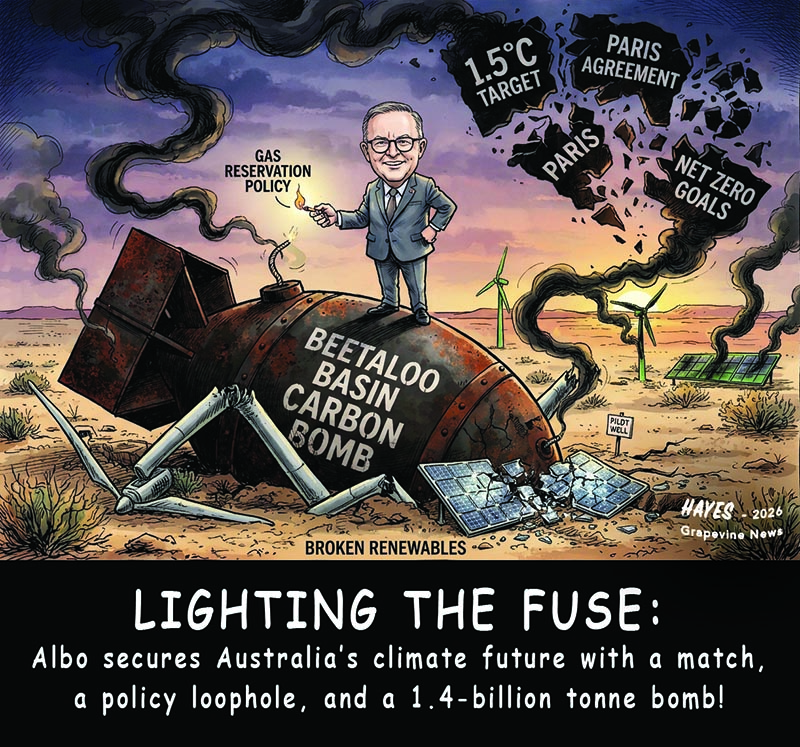
Evidence given by the gas pipeline peak body on October 23 at the inquiry into the Government's proposed Gas Reserve Bill has confirmed that the bill will make it easier to open up the massive Beetaloo Basin in the Northern Territory - - a carbon time-bomb waiting to explode.
The Beetaloo Basin gas project in Australia’s Northern Territory is considered a "carbon bomb"—a term used for massive fossil fuel projects capable of releasing more than 1 billion tonnes of carbon dioxide—because of its immense scale of potential greenhouse gas emissions that environmental groups and scientists warn could derail global climate targets.
Australian Pipelines and Gas Association (APGA) Head of Policy, Ms Catriona Rafael, told the inquiry: “More gas in the domestic market means more gas that has to get to customers... I certainly think it will make it easier to reach FID (final investment decision) for those projects [that will connect the Beetaloo to the east coast market and Darwin].”
So, the Government has a choice to make: do a terrible deal with the gas-guzzling Liberals for more expensive energy bills and a fracking free-for-all, or join the nearly two in three Australians who want a gas export tax.
4 November 2026
ALAN HAYES
DEEP in the semi-arid expanse of the Northern Territory’s Barkly region, a mechanical valve turned. Gas began flowing into the local grid from a pilot fracking project in the Beetaloo Basin. Federal Resources Minister Madeleine King declared it an "historic moment" for national energy security. However, climate scientists and environmental economists see something entirely different: the detonation of a "carbon bomb" that threatens to sink Australia’s climate targets, drain its economy, and reveal structural flaws in the Albanese government's domestic energy strategy.
As the global community shifts toward renewables, Australia’s decision to open a massive new fossil fuel frontier highlights a stark contradiction between official climate rhetoric and economic reality. The unfolding situation at the Beetaloo Basin underscores why this massive project is a bad deal for everyday Australians, why the government’s newly legislated domestic gas reservation policy is fundamentally unsuited to fix it, and why the deliberate omission of "Scope 3" export emissions represents a dangerous form of climate accounting.
Anatomy of a carbon bomb
The phrase "carbon bomb" is not merely activist hyperbole. In climate science, it refers specifically to any fossil fuel extraction project capable of releasing more than 1 billion tonnes of carbon dioxide- over its operational life. The Beetaloo Basin meets this threshold.
Spanning over 2.8 million hectares, the Beetaloo contains one of the largest untapped onshore shale gas reserves on Earth. Environmental groups like Market Forces calculate that if the basin is fully developed and its gas is extracted and burned, total lifecycle emissions will reach between 1.2 billion and 1.4 billion tonnes of greenhouse gases. To put that number into perspective, it represents approximately three times Australia’s entire annual carbon footprint across all sectors combined.
On an annual basis, independent modelling reveals that full-scale fracking in the basin would pump up to 49 million tonnes of carbon dioxide into the atmosphere each year. This single regional development would single-handedly increase Australia’s national emissions by roughly 11%, completely undermining the emission reductions targeted by federal climate policies like the Safeguard Mechanism.
The climate irony is sharpest in the Northern Territory itself. While local newspapers run headlines celebrating the "Golden Era" of Territory energy, meteorological forecasts warn that unchecked global warming will render large swaths of the NT unliveable due to extreme heat over the coming decades.
Why the Beetaloo is a terrible deal for Australia
Proponents of the Beetaloo project present a simple argument: extracting more gas will create regional jobs, generate royalties to reverse the Northern Territory's substantial public debt, and drive down energy prices for households. However, an examination of the project's economics reveals that the long-term liabilities far outweigh the short-term profits.
Despite what an examination of the project’s economics has revealed, under intense political pressure, federal and territory authorities claim that the Beetaloo will comply with stringent environmental standards. Yet under current frameworks, these shale gas facilities are only required to offset a tiny fraction of their total pollution using carbon credits. The offset ratio gap clearly destroys the federal government and territory authority arguments: actual emissions 100%; required offsets 5%.
The Climate Council has identified a glaring regulatory gap: Beetaloo projects are initially required to offset as little as 5% of their total emissions via domestic credits. Attempting to offset 100% of the basin's real footprint would require up to 2.9 million hectares of dedicated land for tree-planting, completely overwhelming Australia’s carbon offset market and inflating credit prices for other domestic industries trying to decarbonise.
To further exacerbate the negative impact of the project is the reality of high production costs versus domestic energy relief.
The gas in the Beetaloo Basin is locked deep within dense shale rock, requiring extensive, capital—intensive horizontal drilling and hydraulic fracturing (fracking). According to financial analysts cited by The Australian Financial Review, it will take billions of dollars in extra capital just to scale up infrastructure to transport this gas out of the remote desert.
Because shale gas extraction carries high fixed production costs, Beetaloo gas is fundamentally expensive to produce. It cannot be sold cheaply without companies taking a loss. Consequently, pumping high-cost fracked gas across thousands of kilometres of pipeline will not lower domestic utility bills; instead, it locks Australian manufacturing and consumers into high energy prices for decades to come.
Then, of course, when the Beetaloo Project, and all the wonderful promises of a cheap energy future, goes pear-shaped, who picks up the pieces?
As international markets like Japan, South Korea, and the European Union transition toward cheaper renewable energy and enforce carbon border adjustments, the global demand for expensive liquefied natural gas (LNG) is expected to decline.
If global demand falls, Australian taxpayers risk being left with the bill. Over the years, hundreds of millions of dollars in public funds have been funnelled into supporting the infrastructure around the Beetaloo and the associated Middle Arm industrial precinct in Darwin. If the international market shifts, these pipelines and processing facilities risk becoming stranded assets, leaving the public to shoulder the environmental clean-up and economic fallout.
The fallacy of the Albanese Government's Gas Reservation Policy
To address rising energy costs and public anger over multi-national energy profits, the Albanese Government introduced a national Domestic Gas Reservation policy. The core mechanism requires gas companies to reserve 20% of their production for domestic use before exporting the rest as LNG.
While Resources Minister Madeleine King has promoted this scheme as a way to secure a "fair price" for Australian households, energy analysts argue that applying it to new frontiers like the Beetaloo Basin is structurally flawed.
So, why will the 20% Reservation Scheme fail to deliver cheap gas? Quite simply, there are no structural price controls in place. The reservation policy functions by increasing supply volume, assuming market forces will automatically lower costs. However, because the policy rejects an explicit domestic price cap or a resource rent export tax, multi-national producers still retain control over the wholesale price floor.
Unsurprisingly, the Northern Territory government and energy executives have noted that the reservation scheme does not fix the physical reality of the Australian market. The Beetaloo is completely isolated from the major population centres of the eastern states. Without a multi-billion-dollar interstate pipeline network connecting the NT to Queensland and New South Wales, the reserved gas remains physically stranded in the north, doing nothing to lower energy prices in Sydney or Melbourne.
Australian Greens Deputy Leader, Senator Steph Hodgins-May, said that from the start “the Greens were worried Labor was trying to sneak the gas industry through the backdoor with its gas reservation policy. Evidence given on two weeks ago (at the Inquiry) didn’t help.
“A jaw dropping 27 billion tonnes of emissions are in the NT’s Beetaloo Basin. If Labor detonates this climate bomb and opens up this gas field, we can say goodbye to their climate targets and say hello to runaway climate collapse.
“This proposed gas reservation is Labor’s giant and complex distraction from making gas exporters actually pay what they owe in tax. But now we learn it is going to make it easier to open up new gas fields and infrastructure. This is the worst of both worlds.
“This bill will enable gas exports to continue until the year 2128, seventy-eight years after Labor pledges to be net zero. Enough with the duplicity, Labor wants happy gas donors, not a safe climate for everyone.
“Without a significant rewrite, this Bill is going to make the climate crisis worse. They should dump this proposal and tax gas exports now to help Australians with desperately needed cost-of-living relief and funding to genuinely transition our economy.”
So, what does Albo’s pet project achieve in reality? By introducing policies that subsidise and protect the long-term expansion of the gas industry, the federal government inadvertently slows down the roll-out of industrial electrification and renewable energy storage. Gas reservation extends the lifecycle of aging gas-reliant infrastructure instead of accelerating the transition to lower-cost wind, solar, and battery storage.
Rather than lowering energy costs, the reservation policy serves as a political mechanism that allows the government to approve major new fossil fuel developments, while claiming to act in the interest of domestic consumers.
The blind spot of Scope 3 emissions
The most contentious element of the Beetaloo project is the deliberate exclusion of Scope 3 emissions from federal environmental assessments and carbon accounting frameworks. Understanding this omission requires breaking down how greenhouse gas emissions are categorised:
- Scope 1 (Direct): Emissions from drilling and fracking on-site.
- Scope 2 (Indirect): Emissions from electricity used to run operations.
- Scope 3 (Downstream): Emissions generated when gas is exported and burned by international buyers.
The Albanese government's Safeguard Mechanism focuses primarily on Scope 1 and Scope 2 emissions within Australian borders. This approach creates a significant accounting loophole for the Beetaloo Basin. Over 80% of the total carbon footprint of Beetaloo gas will occur as Scope 3 emissions when the fuel is exported overseas and burned by international consumers.
The political and legal fiction of "Not Our Footprint"
By omitting Scope 3 emissions from domestic regulatory approvals, Australian policymakers rely on an international accounting convention where export emissions are counted on the ledger of the importing nation. The gas industry argues that if Japan or China burns Australian gas, it is an international climate responsibility, not an Australian one.
Climate scientists argue that the atmosphere does not care about national borders or accounting definitions. Pumping billions of tonnes of carbon into the global carbon budget worsens climate change regardless of where the match is struck. Burning Australian gas overseas will still cook the planet.
A shifting legal landscape
While federal policy continues to overlook these downstream impacts, the Australian judiciary is beginning to challenge this approach. In an historic ruling, the High Court of Australia delivered a major judgment in MACH Energy Australia v Denman Aberdeen Muswellbrook Scone Healthy Environment Group. In a split decision, the nation's highest court invalidated a fossil fuel project's approval because the planning authority failed to properly evaluate and minimise its Scope 3 greenhouse gas emissions.
While that case turned on specific New South Wales planning statutes rather than federal resource law, legal experts note it establishes a clear precedent: "Community groups now have a clear, High Court-endorsed basis to challenge approvals where authorities haven't properly assessed a project's full carbon footprint... This could dramatically reshape the economic case for continued fossil fuel production in Australia." But watch out for the new Minns' precedent: if you win you lose.
The federal government’s ongoing refusal to assess Scope 3 emissions for major projects like the Beetaloo places it at odds with emerging legal precedents, leaving the project exposed to ongoing litigation and future regulatory uncertainty.
A turning point for Australia's climate stance
The first gas flowing from the Beetaloo Basin to Darwin represents a critical choice for Australia’s energy and climate policy.
On one side, the federal government and the gas industry present the project as a path toward regional development and managed energy security. On the other, the scientific reality shows that the Beetaloo is a major carbon project that conflicts with global targets to limit warming to 1.5°C.
By backing the project through policies, like the gas reservation scheme and continuing to overlook downstream export emissions, the government protects short-term fossil fuel investments at the expense of long-term climate stability. As global energy markets transition and local climate impacts increase, the decision to develop the Beetaloo Basin leaves Australia exposed to substantial economic and environmental risks.
The economic and environmental math surrounding the Beetaloo Basin has ultimately led to a singular conclusion: mega-frontiers like the Beetaloo should be permanently abandoned.
Beyond the immediate threat they pose to global 1.5°C climate thresholds, these fossil fuel projects operate under an outdated domestic framework that effectively subsidises corporate pollution, while depriving the Australian public of its rightful economic return.
A primary driver of this economic imbalance is the structural failure of the Petroleum Resource Rent Tax (PRRT). Originally designed to ensure the community profits from the extraction of non-renewable resources, the PRRT has become heavily compromised by generous tax concessions. Because gas miners are permitted to carry forward immense, self-reported exploration and development deductions—often accumulated over decades—they routinely wipe out their taxable profits on paper. As a result, multi-national conglomerates can extract billions of dollars’ worth of sovereign Australian gas from basins like the Beetaloo while paying virtually zero PRRT for the first several years of production. This loophole transforms finite public assets into private windfall profits, leaving everyday citizens to shoulder the structural costs of environmental degradation and rising domestic energy bills.
To correct this imbalance and manage the economic risks of the energy transition, economic policy experts advise that Australia should abandon new greenfield gas developments and restructure its resource taxation by introducing a flat 25% resources tax on all gross oil and gas revenue.
Unlike the loophole-prone PRRT, a flat 25% tax on gross revenue cannot be avoided through clever accounting or carried-forward deductions. It ensures that from the very first day a resource is extracted, the Australian public receives a guaranteed dividend.
Implementing a strict 25% resource tax serves two critical purposes:
- Funding the Transition: The billions generated can directly fund the rapid rollout of industrial electrification, grid storage, and community-led renewable initiatives.
- Levelling the Economic Playing Field: Removing hidden subsidies forces gas projects to face their true market costs. Without tax loopholes, high-cost fracking ventures like the Beetaloo become financially unviable compared to cheaper, domestic renewable energy.
Continuing to approve projects like the Beetaloo under the current tax regime represents an economic and environmental vulnerability. Shifting policy to abandon new gas frontiers, while implementing a comprehensive 25% resource tax, allows Australia to protect its climate targets, secure its financial sovereignty, and fund a fair transition toward a renewable economy.






SUBSCRIBE FOR FREE to the Grapevine News Online and to the monthly e-book edition of the Grapevine Community Weekly. Our online news platform and monthly newspaper is about real local news and events. We will not spam you or share your details with third parties.
