






Australia's fossil fuel
standoff sank COP31
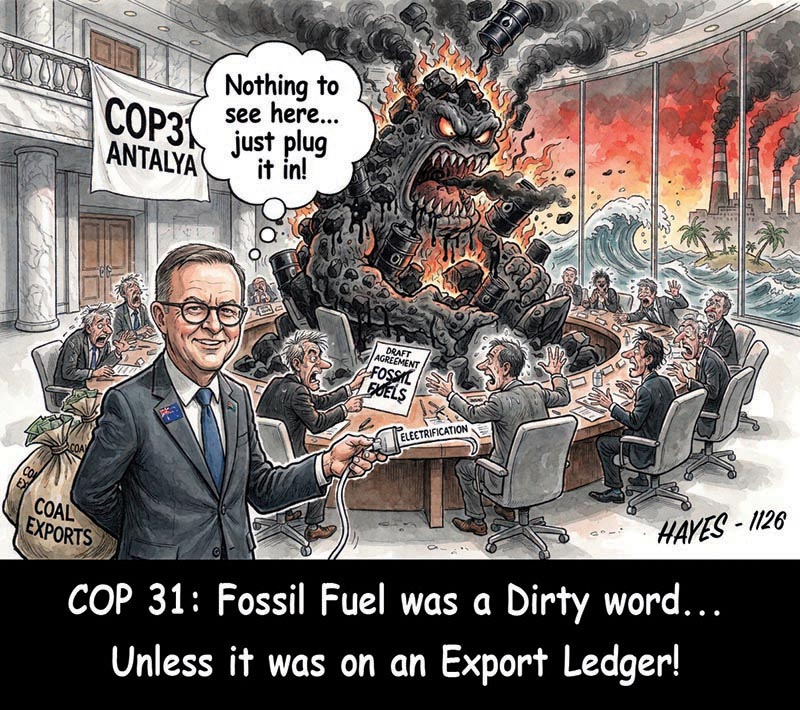
The 31st United Nations Climate Change Conference (COP31) concluded in historic disarray on Sunday, 22 November 2026, collapsing after running more than 40 hours past its scheduled deadline without an overarching political agreement; leaving little doubt that the Elephant in the Antalya Room was Australia. Co-hosted by Turkey and led in formal negotiations by Australia, the summit ended in what observers from ABC Pacific and The Guardian described as the most clear-cut diplomatic breakdown since the Copenhagen summit of 2009.
25 November 2026
ALAN HAYES
AT the heart of the COP31 collapse was an irreconcilable dispute over whether the final cover decision would explicitly name fossil fuels—coal, oil, and gas—as the primary driver of global warming.
While a coalition of petrostates blocked any direct reference to phasing out fossil fuels, nearly 40 nations, including the 27-member European Union and vulnerable Pacific Island states, refused to sign a document that erased the landmark commitments made three years earlier at COP28 in Dubai. For Australia’s Prime Minister Anthony Albanese and Minister for Climate Change and Energy Chris Bowen, the failure exposed the acute geopolitical limits of their "global electrification" strategy and highlighted the growing international scrutiny over Australia’s dual identity as both a self-styled clean energy champion and one of the world’s largest exporters of coal and gas.
The marathon collapse over two words
The summit in the Mediterranean resort city of Antalya was originally scheduled to conclude on Friday, 20 November 2026. Instead, exhausted delegates pulled consecutive all-nighters in windowless plenary halls as negotiations stretched more than 48 hours into overtime, making COP31 the longest UN climate conference on record.
Under the historic joint-presidency arrangement brokered prior to the summit, Turkey's Environment, Urbanisation and Climate Change Minister Murat Kurum served as COP31 President, while Australia’s Chris Bowen was designated as the President of Negotiations, tasked with steering the complex multilateral text toward consensus. Going into the final weekend, Bowen and Kurum faced a hardened bloc of fossil-fuel-producing nations—led by Saudi Arabia and backed by Russia and India—that insisted they would veto any cover decision containing the words "fossil fuels".
Seeking a diplomatic middle ground to preserve consensus, the Turkish-Australian leadership released a revised draft cover text in the early hours of Sunday morning. Rather than restating the COP28 UAE Consensus call to "transition away from fossil fuels," the draft proposed that nations merely "recall" the 2023 Dubai decision "in its entirety". In place of explicit phase-out language, the text offered a vague commitment to an "irreversible transition towards lower greenhouse gas emissions" alongside explicit backing for carbon capture, utilisation, and storage (CCUS) technologies.
The compromise backfired immediately. Given roughly three hours to review the text before the closing plenary, a broad progressive coalition revolted. Addressing the plenary on behalf of the European Union, Irish Climate Minister Darragh O’Brien rejected the draft outright.
"It is unconscionable that we would have a climate pact that makes no mention of fossil fuels, which is the key driver of climate change," O’Brien told delegates.
Close to 40 countries—including the United Kingdom, Norway, Panama, Belize, Vanuatu, and the Marshall Islands—registered formal objections, refusing to endorse a text they viewed as a retreat from settled science. Former US Vice President Al Gore labelled the outcome an "outrage," criticising the UN consensus model for granting a handful of petrostates effective veto power over mentioning the primary cause of the climate crisis.
By Sunday afternoon in Antalya (early Monday morning AEDT), Bowen and Kurum conceded defeat. With "unbridgeable divides" preventing a cover decision, the conference closed with only minor technical agreements on a "just transition" mechanism and adaptation funds, leaving the central question of global emissions unaddressed.
Albanese, Bowen, and the 'Global Electrification' gamble
For the Albanese government, which had campaigned heavily to co-host COP31 in partnership with Pacific Island nations, the collapse represented a major diplomatic setback. Throughout the two-week gathering, Bowen and Albanese sought to reframe the stalled fossil fuel debate around a technocratic alternative: rapid global electrification.
Working alongside Turkey, Australia championed the "35-by-35 Global Electrification Pledge," an initiative urging nations to expand electricity’s share of total final global energy consumption from roughly 23 per cent to 35 per cent by 2035. Speaking to media in Antalya, Bowen argued that electrification was the practical mechanism through which the world would naturally move away from coal, oil, and gas.
"Electrification is the key to transitioning away from fossil fuels," Bowen stated during the negotiations. "The question now is not whether we should transition away from fossil fuels; it’s about how we do so."
Despite backing from over 90 nations, the 35 per cent electrification pledge stumbled over the absence of clean-energy mandates and requirements to cap fossil fuel production, while heavy reliance on carbon capture technologies drew criticism as an industry loophole. Prime Minister Albanese faced domestic scrutiny for dodging direct references to fossil fuels in his address and for a pre-summit hot-mic gaffe, which he dismissed as lighthearted.
Australia’s double-edged sword: Coal revenue vs. climate leadership
Australia’s dual role as a self-styled climate advocate and a fossil fuel giant cast a shadow over its presidency. According to Climate Analytics, Australia ranks as the world’s second-largest coal exporter and third-largest LNG exporter, accounting for 4.3% of global fossil CO₂ emissions in 2025. Black coal exports reached 352 million tonnes in 2025, with projections holding near 350 million tonnes annually through 2030 and exported emissions expected to hit ~900 million tonnes of CO₂ per year by 2040.
Data from Global Witness noted that Australian fossil fuel exports over the decade following the Paris Agreement generated 12.4 billion tonnes of CO₂—surpassing the combined domestic emissions of 44 least-developed nations.
Despite legislating net-zero targets domestically, the government has approved 37 to 38 new or expanded fossil fuel projects since 2022, prioritising trade partner energy security and mining royalties. Civil society groups criticised this contradiction, arguing it represented an untenable conflict of interest.
Pacific frustration and fractured finance
Pacific Island nations, whom Canberra had courted via the "COP31 Pacific Partnership," expressed deep disappointment. Delegations sought concrete phase-out timelines and binding adaptation finance, but negotiations fractured over the Global South's demands for explicit public funding versus wealthy nations' reluctance. While Chris Bowen defended Australia's efforts, insisting real-world transitions are irreversible, the breakdown left Pacific states feeling abandoned.
What happens next?
Though the Paris Agreement and Dubai commitments remain intact, the Antalya breakdown has intensified questions regarding the viability of UN consensus diplomacy. As attention pivots to Ethiopia for COP32 in 2027, the Albanese administration faces severe domestic and international pressure to reconcile its clean-energy ambitions with its multi-decade export pipeline.







SUBSCRIBE FOR FREE to the Grapevine News Online and to the monthly e-book edition of the Grapevine Community Weekly. Our online news platform and monthly newspaper is about real local news and events. We will not spam you or share your details with third parties.
