





Fast-tracked 'AI Factory' sparks outcry
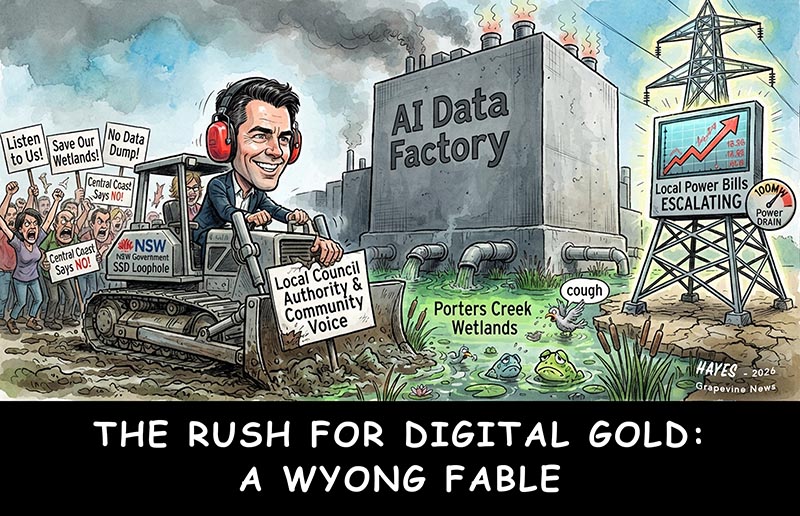
An escalating battle over the future of the Central Coast landscape is taking shape in North Wyong, where a proposed hyperscale data centre has become the latest flashpoint in the Minns Government’s aggressive push to secure New South Wales as the Southern Hemisphere’s premier AI and digital infrastructure hub.
The proposal for the Lucca Road Data Centre—spearheaded by the Castle Group—seeks to construct a massive, two-storey facility operating 24 hours a day with an immense power capacity of up to 150 megawatts, which includes the running of ancillary equipment. Planned for the North Wyong site is a behemoth, which has now officially entered the state’s rigorous but controversial State Significant Development (SSD) planning stream, that will nothing more than pander to the profits of Californian tech billionaires while leaving the Central Coast community high and dry.
While tech advocates view the development as a critical anchor for the modern digital economy, a growing coalition of local residents, environmentalists, and political activists are soundly rejecting the proposal. Critics label the project an "AI factory" that threatens fragile local ecosystems while offering negligible employment benefits to the surrounding community
28 October 2026
ALAN HAYES
AT the heart of the community's fury is a profound sense of disenfranchisement. In August 2026, the Minns Labor Government quietly overhauled planning instruments for State Significant Developments. The regulatory shift effectively doubled the threshold required to trigger an independent review by the Independent Planning Commission (IPC), raising the mandate from 50 to 100 unique community objections. Furthermore, formal objections from local municipal councils no longer serve as an automatic trigger for independent state oversight.
"It feels like a calculated ambush on local democracy," said one Wyong resident, whose family home sits less than 600-metres from the industrial zone. "They are stripping away council protections and muting our community’s voice, all to hand tech billionaires a frictionless path through our backyards."
The state’s adjusted framework runs parallel to Premier Chris Minns' new "NSW Data Centre Guidelines". The policy pledges a lightning-fast 75-day assessment pathway for data centre proposals, provided developers comply with foundational environmental and resource principles. While the government insists this policy maintains high planning standards, community groups claim it amounts to "ramming through" heavy industrial projects with barely a fraction of the traditional community consultation.
Rhiannon Schembri, Greens candidate for Gosford in the March 2027 elections, said "The Greens are calling for a moratorium on data centre development here on the Central Coast and across the country.
"The NSW government, led by Chris Minns, is attempting to ram these projects through as State Significant Developments with barely any community consultation or planning oversight. Our communities will have to bear the costs of these AI factories, and there has been no clear articulation of what - if any - benefits they will bring.
"The major parties love to repeat the AI industry's talking points that data centres will create an economic boom for Australia. But it's clear from previous projects around the world that data centres create very few ongoing local jobs. The development application report for the Wyong data centre does not even provide an estimate of how many jobs it will create. The biggest employment impact of the project will likely be to take construction workers away from building homes, which we so desperately need in the midst of a housing crisis."
The environmental dilemma: wetlands and power grids
The physical geography of the proposed Lucca Road site has raised alarm bells among local conservationists. The plot sits adjacent to key industrial sectors but crucially borders ecological buffer zones, including the vulnerable Warnervale wetlands.
Local community notices highlight a litany of environmental risks associated with a 150MW facility operating around the clock. To ensure uninterrupted uptime for server stacks, data centres rely on massive banks of back-up diesel generators and extensive on-site fuel storage facilities. Because the proposed Wyong lot is structurally mapped as both flood-affected and bushfire-prone, critics argue that storing hundreds of thousands of litres of combustible diesel fuel poses an unacceptable risk to local wildlife corridors and public safety.
Furthermore, the operational realities of hyperscale data centres are notoriously resource-intensive. Activist groups, including NSW Socialists, have recently mounted campaigns demanding an immediate moratorium on data centre construction across the state. They point to secondary data from Western Sydney showing that clusters of massive data servers can elevate localised land temperatures by up to 2°C, generate persistent low-frequency humming from industrial cooling plants, and trigger steep increases in regional energy demands.
"Data centres are essentially rapacious utility sponges," an energy analyst noted. "A 150MW facility draws an amount of power equivalent to tens of thousands of residential homes. If the grid isn't fortified with dedicated renewable inputs, everyday consumers on the Central Coast could face upward pressure on their power bills."
Rhiannon Schembri said that the proposed Wyong data centre would be built on the edge of the ecologically sensitive Porters Creek Wetland, home to numerous endangered species and ecological communities. "The plans rely on an unrelated development approval from over 15 years ago, and ignore the need for proper drainage engineering to protect the wetland ecosystem from toxic runoff and flood damage," she said.
"The impacts of constant heat and noise pollution from this development on our precious wildlife will be significant and clever reporting and offsetting tricks don't change this, no matter how the Labor party tries to spin it. It's clear from previous projects in the USA and elsewhere that data centres negatively impact quality of life for people who live nearby, and the same is likely to be true here.
"Data centres are energy-guzzling behemoths, and with this facility plugged into our local power grid, Coasties can only expect power bills to go up. People are already struggling to afford essentials - the last thing we need is a big corporation hoovering up our electricity supply.
"All the progress we have made as a community on transitioning away from fossil fuels could be undone as these AI factories pop up across the country.
High cost, low yield?
For Central Coast residents, the economic arithmetic of the data centre simply does not add up. While traditional manufacturing plants or commercial hubs of this scale generate hundreds of localised jobs, automated data facilities require very little human intervention once built.
The completed Lucca Road facility is expected to sustain only a skeleton crew of permanent operational staff—estimated between 10 and 30 ongoing roles, predominantly covering facilities engineering, on-site security, and basic IT hardware maintenance.
"We are being asked to absorb all the structural costs—the noise pollution, the strain on our electrical grid, the ecological threat to the wetlands—for an infrastructure asset that employs fewer people than a local supermarket," said an organiser behind a local community petition. "There is no clear articulation of what actual, tangible benefit this brings to the people of Wyong."
Local trades transmission groups have also voiced more complex economic anxieties. While the initial construction boom will provide a short-term surge for local contractors, some analysts warn it could inadvertently exacerbate existing labor and material shortages. The intense demand for specialised technicians—particularly commercial industrial electricians—risks drawing talent away from residential housing projects, potentially driving up local construction and housing costs during an active statewide affordability crisis.
"We have to ask," said Rhiannon Schembri: "what do we get out of AI? Right now, despite the hype, AI isn't "revolutionising" our workplaces - it's undermining them. AI companies have stolen the work of our writers and artists and now they're selling it to corporate bosses who want to replace us.
"With data centres harming our communities and environment, and chatbots and AI "agents" hurting our livelihoods, regular people are paying twice over just to appease Silicon Valley billionaires. Our leaders are supposed to protect our interests, and that means standing up to Big Tech until we can work out how to make AI work for Australians."
The case for the digital "Engine Room"
Faced with mounting localised pushback, the Minns Government and industrial developers are holding a firm line, framing hyperscale data centres as non-negotiable infrastructure for the 21st century, an argument that is unconvincing for the community.
Government representatives argue that data centres are the foundational engine rooms of modern society. The computing power generated at sites like Lucca Road does not merely feed entertainment algorithms; it secures the massive data pipelines required to run advanced health networks, commercial banking systems, emergency services, and transit grids. Without local state-of-the-art server infrastructure, NSW risks falling behind in technological self-reliance and global investment.
In an official project briefing, the Castle Group emphasised its commitment to navigating the NSW planning process transparently and addressing local expectations. The developer noted that the Lucca Road site holds historical development consents for specific civil, drainage, and bulk-earthworks, which they are currently reviewing alongside utility providers and First Nations communities.
Furthermore, proponents point to the strict "bring-your-own" economic mandates embedded within the state's updated guidelines. Under the current regulatory framework, hyperscale developers are legally required to fully fund their own substantial utility upgrades. The policy is designed to force multi-billion-dollar tech consortiums to invest directly in new renewable energy generation and grid transmission lines, technically offsetting broader pressures on the state grid and shifting infrastructure costs away from everyday taxpayers.
Despite all the rhetoric, data centres still steal from society!
A road full of pitfalls
As it stands, the Lucca Road Data Centre is only in its foundational legislative phase. The project is currently sitting at the "Prepare SEARs" (Secretary's Environmental Assessment Requirements) stage on the NSW Planning Portal, where the government dictates the exact environmental, acoustic, and diagnostic studies the developer must conduct.
The Castle Group anticipates finalising its comprehensive Environmental Impact Statement (EIS) and lodging its formal planning application in early 2027. Once submitted, the application will enter a mandatory public exhibition phase, giving Central Coast residents a brief window to submit formal public entries.
With community opposition organising rapidly across social media and digital petition platforms, the upcoming public exhibition is poised to be a volatile testing ground for the Minns Government's streamlined development agenda. Whether the Central Coast becomes a key node in the global AI race or a successful monument to grassroots environmental resistance remains to be seen.
The escalating controversy over the Wyong Data Centre poses a distinct political headache for the Minns Labor Government as it prepares for the NSW State election on 13 March 2027. Operating as a minority government with 46 seats, Labor cannot afford to alienate crucial regional electorates. The Central Coast has historically been a vital battleground, and forcing through a highly unpopular "AI factory" via the fast-tracked State Significant Development (SSD) pathway risks severe electoral blowback.
By bypassing Central Coast Council and curbing community objection thresholds, the government has inadvertently handed the Liberal-National Coalition, minor parties, and independent challengers a powerful narrative. Opposition candidates are poised to weaponise the Wyong development as proof of Labor’s perceived centralisation of power, disregard for regional environment frameworks, and lack of consultation.
Furthermore, as cost-of-living and energy grid stability remain paramount voter concerns, the massive 150-megawatt power demand of the facility leaves the government exposed to criticisms regarding household utility costs. If localised opposition cohere into a coordinated regional movement over the next few months, the Wyong dispute could directly threaten Labor’s hold on crucial Central Coast seats, complicating their path to a majority term in 2027.
The "Trump" approach to tech infrastructure
To community advocates on the Central Coast, Premier Chris Minns’ management of the Wyong Data Centre development echoes a brand of unilateral executive execution more commonly associated with leaders like the 'lunatic in the White House', Mad King Donald. Though operating from opposite ends of the traditional political spectrum, critics argue that Minns has deployed a similar transactional playbook: cutting through regulatory red tape, prioritising heavy corporate investment, and systematically neutralising local opposition to achieve an overriding economic objective.
This perceived authoritarian handling is anchored in a deliberate restructuring of the state's planning landscape. By empowering a handpicked four-person committee—the Investment Delivery Authority—and altering Independent Planning Commission (IPC) thresholds, the government has essentially rewritten the rulebook. This top-down executive approach effectively insulates multi-billion-dollar tech consortiums from grassroots friction. When the state unilaterally doubles the objection threshold from 50 to 100 signatures to weaken local protest, it mirrors the Trumpian tactic of weakening institutional checks and balances to push through controversial industrial projects.
Furthermore, the Minns Government’s defensive rhetoric employs a familiar populist 'us verusus them' dichotomy. Local environmental and council anxieties regarding the Warnervale wetlands are routinely framed as obstructionist hurdles blocking essential modern progress. By labelling these data warehouses as non-negotiable "factories of the modern economy", Minns has adopted a transactional leadership style: suggesting that the end—insulating the NSW economy from recession—fully justifies the heavy-handed means of stripping regional communities of their planning voices. This creates a volatile political narrative for Labor on the Central Coast, where voters increasingly feel that democratic oversight has been sacrificed for private equity interests.
Chris Minns has now left his government balancing on a highly precarious political tightrope heading into the March 2027 state election. His government’s management of data centre approvals—most recently the controversial Wyong data centre proposal—has accelerated this risk.






SUBSCRIBE FOR FREE to the Grapevine News Online and to the monthly e-book edition of the Grapevine Community Weekly. Our online news platform and monthly newspaper is about real local news and events. We will not spam you or share your details with third parties.
