






Deep trouble down under:
the $368 billion IOU
On the sun-drenched shores of Cockburn Sound, just south of Perth, construction crews are working around the clock to transform HMAS Stirling into one of the most strategically critical naval hubs in the Indo-Pacific. Backed by an $8 billion federal infrastructure splurge, reinforced piers, nuclear-certified maintenance yards, and housing precincts are rising from the coastal scrub.
To the Albanese government, the bustling activity in Western Australia is proof that the trilateral AUKUS security pact with the United States and the United Kingdom is delivering jobs, industrial sovereignty, and a generational leap in national defence. Yet to a growing chorus of former prime ministers, retired military chiefs, economists, and strategic analysts, the celebratory media tours—derided by political commentators as a "festival of AUKUS"—mask a grim reality.
Five years after the pact was unveiled in secrecy, critics warn that Australia has locked itself into a $368 billion gamble with no contractual guarantee of receiving a single nuclear-powered submarine, while simultaneously turning its western coastline into a forward operating base for American war planning against China.
In early November 2026, a privately funded, crowdfunded Independent Public Inquiry into AUKUS—chaired by former Chief of the Australian Defence Force Admiral Chris Barrie and former Labor cabinet minister Peter Garrett—delivered a blistering verdict. Calling the agreement "the worst, riskiest and most costly defence decision ever made by an Australian government," the report warned that Australia faces a catastrophic strategic trap: paying billions to subsidise foreign shipyards, watching its current submarine fleet limp toward retirement, and inviting retaliatory strikes in a conflict over Taiwan that Australia may not even wish to fight.
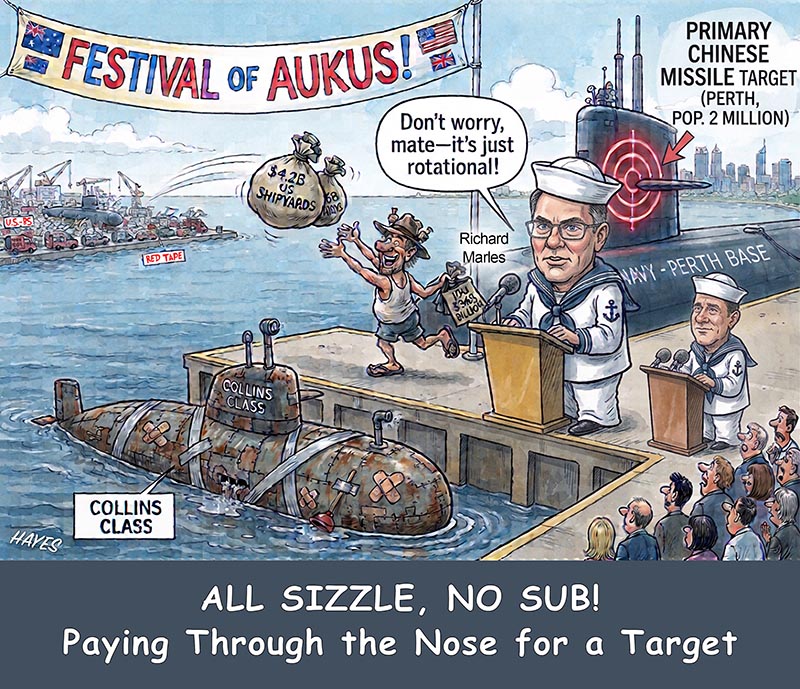
Has a multi-billion dollar target at HMAS Stirling led to a honorary U.S. Naval cadetship for Richard Marles and Pat Conroy?
18 November 2026
ALAN HAYES
AT THE HEART of the economic case against AUKUS is an extraordinary asymmetry in financial risk. Under the "Optimal Pathway" announced in 2023, Australia committed to paying roughly A$4.2 billion (US$3 billion) to expand American submarine shipyards and another A$4.6 billion (£2.4 billion) to bolster British industrial capacity. Unlike standard commercial defence contracts, these billions are non-refundable subsidies.
In return, Australia was promised between three and five US Virginia-class nuclear-powered attack submarines (SSNs) starting in the early 2030s to bridge the gap until a new, jointly designed SSN-AUKUS fleet can be built in Adelaide in the 2040s.
However, the numbers inside American shipyards tell a sobering story. To replace its own retiring Los Angeles-class submarines and spare boats for Australia, the US Navy has stated it needs American shipyards to produce 2.33 Virginia-class boats per year. Between 2024 and 2026, actual US production averaged just 1.1 submarines annually, hindered by severe skilled labour shortages, supply-chain bottlenecks, and competing priority for the US Navy’s new Columbia-class ballistic missile submarines. Even the US Navy admits it will not reach a production rate of two boats per year until 2032 at the earliest.
The strain has already forced major downgrades to Australia’s expectations. In May 2026, following talks in Singapore, the Australian, US, and UK governments quietly confirmed a major revision to the deal. Instead of receiving two used submarines and one brand-new, upgraded Block VI Virginia-class boat fitted with an 84-foot payload module, Australia will now receive three secondhand Block IV submarines drawn directly from the existing US Navy fleet.
While Defence Minister Richard Marles (the honorary Kentucky colonel) rhetoric framed the shift as a practical move that saves money and simplifies maintenance across identical vessels, critics labelled it an AUKUS "bait and switch." Secondhand Block IV boats carry smaller weapon payloads and have significantly less remaining reactor life than a newly built submarine—yet taxpayers remain on the hook for a program projected to cost up to $368 billion over three decades, or closer to half a trillion dollars once nuclear waste storage and disposal are factored in.
Worse still, there is no legal guarantee that even those three used submarines will ever be handed over. Under legislation passed by the US Congress, a future American president must formally certify before any transfer takes place that selling a submarine to Australia will not degrade the US Navy’s own undersea capabilities.
Former Prime Minister Malcolm Turnbull has repeatedly pointed out the absurdity of expecting an American commander-in-chief to weaken the US fleet during a period of acute tension with Beijing. Top Pentagon officials have echoed that skepticism; Elbridge Colby, appointed undersecretary of defence policy in the Trump administration, previously remarked that it would be "crazy" for Washington to have fewer Virginia-class submarines in the Pacific if tensions over Taiwan flared.
Public confidence reflects these doubts: an October 2026 poll by the United States Studies Centre found that just 31 percent of Australians believe the promised submarines will actually arrive.
Meanwhile, think tanks, such as The Australia Institute, argue that AUKUS is cannibalising the rest of the Australian Defence Force. Consuming roughly 1.5 percent of all federal spending—and up to 11 percent of the future defence budget—the nuclear submarine program leaves less money for long-range missiles, uncrewed underwater drones, air defence systems, and surface vessels that could be delivered within years rather than decades.
The Collins-Class tightrope: What happens if the subs never arrive?
If Washington invokes its escape clause in the 2030s and keeps its Virginia-class submarines, Australia will face a stark reality: a complete collapse of its sovereign undersea warfare capability.
Senior defence official Hugh Jeffrey acknowledged the severity of this vulnerability in March 2026, warning plainly that Australia will have no submarines if the AUKUS pathway fails, because the government is pursuing the nuclear option without a Plan B.
To prevent a capability gap before the 2030s, the Royal Australian Navy is relying entirely on its six ageing Collins-class diesel-electric submarines. Designed in the 1980s and commissioned between 1996 and 2003, the Collins boats were originally intended to be retired in the mid-2020s. Instead, they are being pushed toward 40 or even 50 years of service—an unprecedented lifespan for conventional submarines operating in harsh ocean conditions.
In 2024, fleet availability dipped sharply after corrosion issues plagued multiple hulls. To keep the boats viable into the 2040s, the government launched an $11 billion Life-of-Type Extension (LOTE) program, beginning with HMAS Farncomb in mid-2026.
Yet that life-extension effort is itself mired in trouble. In May 2026, a scathing report by the Australian National Audit Office (ANAO) revealed that Defence’s management of the LOTE project had suffered from ballooning costs, 53 contract variations, and flawed planning originally tied to the cancelled French Attack-class submarine deal. Because of technical risks and schedule pressures, the government was forced to scale back the upgrades, opting to refurbish existing machinery rather than install new engines and generators across all six boats.
With each submarine requiring roughly two years in dry dock for its life extension—and with routine maintenance cycles—Australia can often keep only two or three Collins-class boats operational in the water at any given time. If the US fails to transfer Virginia-class submarines in the 2030s, and if the first Australian-built SSN-AUKUS submarine is delayed beyond the 2040s as many naval architects predict, the Collins fleet will simply age out of service. Australia—an island continent dependent on maritime trade routes for fuel, medicine, and economic survival—would find itself blind beneath the waves, stripped of its most potent naval deterrent.
Perth on the front line: The Taiwan trap
While Australia waits years for submarines it may never own, the United States is receiving immediate, tangible strategic value from AUKUS—and critics warn Australia is bearing the existential risk.
Beginning in late 2027, HMAS Stirling will host Submarine Rotational Force – West (SRF-West). Under this arrangement, up to four US Virginia-class submarines and one British Astute-class submarine will operate out of Perth on continuous rotation, supported by more than 1,200 foreign military personnel and their families. In October 2026, the USS Colorado docked at HMAS Stirling for a major maintenance period overseen by over 100 Australian technicians—a dry run for its scheduled return in 2027 as the first rotational boat.
For the Pentagon, basing nuclear-powered attack submarines in Western Australia is a strategic masterstroke. Situated on the Indian Ocean edge of the Indonesian archipelago, HMAS Stirling sits safely outside the immediate range of China’s dense coastal anti-access missile networks in the South China Sea, while offering rapid transit routes to the Strait of Malacca and the Western Pacific. Alongside a planned $8.5 billion dry-dock and repair precinct at nearby Henderson, Perth provides the US Navy with vital intermediate maintenance capacity it desperately lacks at home.
To critics, however, "rotational" is a diplomatic euphemism for a permanent American forward operating base on Australian soil—one over which Canberra has minimal operational control.
Former Prime Minister Paul Keating, former Foreign Minister Gareth Evans, and strategic thinkers such as Hugh White have warned that integrating Australian bases and personnel into US undersea operations dramatically compromises Australian sovereignty. Because US submarines operating out of Perth will operate under American command and control, any major crisis between Washington and Beijing—most plausibly a war over Taiwan—would immediately entangle Australia.
If the United States goes to war with China over Taiwan, US nuclear attack submarines stationed at HMAS Stirling would be among the primary offensive weapons deployed to blockade Chinese ports, hunt People’s Liberation Army Navy (PLAN) vessels, and launch long-range Tomahawk cruise missiles against mainland Chinese targets.
Under the laws of armed conflict, a port that houses, repairs, and resupplies combatant warships actively engaged in hostilities becomes a legitimate military target. Strategic analysts warn that Beijing would view HMAS Stirling—alongside joint intelligence facilities like Pine Gap in the Northern Territory and the Harold E. Holt Naval Communication Station at North West Cape—as critical nodes in the American war machine.
China possesses an expanding arsenal of long-range conventional ballistic missiles, hypersonic glide vehicles, and nuclear weapons capable of reaching Western Australia. In a high-intensity war over Taiwan, Chinese military planners would face overwhelming incentives to neutralise HMAS Stirling early in the conflict to prevent US submarines from reloading and re-entering the fight. Perth, a sprawling metropolitan city of more than two million people located less than 40 kilometres north of the naval base, would suddenly find itself living in the shadow of long-range missile strikes.
Furthermore, analysts writing for the Australian Strategic Policy Institute (ASPI) have highlighted a looming nuclear policy dilemma. The United States plans to deploy a new sea-launched nuclear-armed cruise missile (SLCM-N) onto its Virginia-class attack submarines in the 2030s. Because Washington maintains a strict policy of neither confirming nor denying the presence of nuclear weapons aboard its vessels, hosting rotational US submarines in Perth risks placing Australia in breach of the 1985 South Pacific Nuclear Free Zone Treaty (https://treaties.un.org/doc/publication/unts/volume%201445/volume-1445-i-24592-english.pdf) (Treaty of Rarotonga), which prohibits the stationing of nuclear explosive devices on member territory.
The counterargument—And an unresolved dilemma
Supporters of AUKUS, including Defence Minister Marles and strategic scholars like John Blaxland, argue that critics fundamentally misunderstand the nature of deterrence. In their view, an assertive China already threatens the regional balance of power, and a stronger US-Australian alliance makes a conflict over Taiwan less likely by convincing Beijing that aggression would fail. They argue that nuclear-powered submarines—able to travel faster, stay submerged indefinitely, and patrol vast distances—are the only vessels capable of defending an island nation responsible for 10 percent of the Earth's ocean surface.
Yet even as the government presses ahead with billions in spending, the core tension of AUKUS remains unresolved. Polling by the Lowy Institute shows that while 68 percent of Australians support the concept of acquiring nuclear-powered submarines, fewer than a quarter believe the government has properly explained the deal.
For critics, the ledger is starkly unbalanced. Australia is spending hundreds of billions of dollars, propping up foreign shipyards, nursing an ageing Collins-class fleet through a high-risk life extension, and offering up its western coastline as an unsinkable aircraft carrier for American war planning—all in the hope that a future US president will choose Australia’s security over America’s own naval shortages. If that hope proves misplaced, Australia will be left with the bill, the target on its back, and no submarines to defend itself.






SUBSCRIBE FOR FREE to the Grapevine News Online and to the monthly e-book edition of the Grapevine Community Weekly. Our online news platform and monthly newspaper is about real local news and events. We will not spam you or share your details with third parties.
