






Calls for fish and yabby PFAS testing
Ourimbah Valley residents are calling for targeted PFAS testing of fish and yabbies in Ourimbah Creek following information presented at a community meeting on 15 August highlighting the potential for PFAS to accumulate in aquatic animals even where concentrations in surrounding water are relatively low.
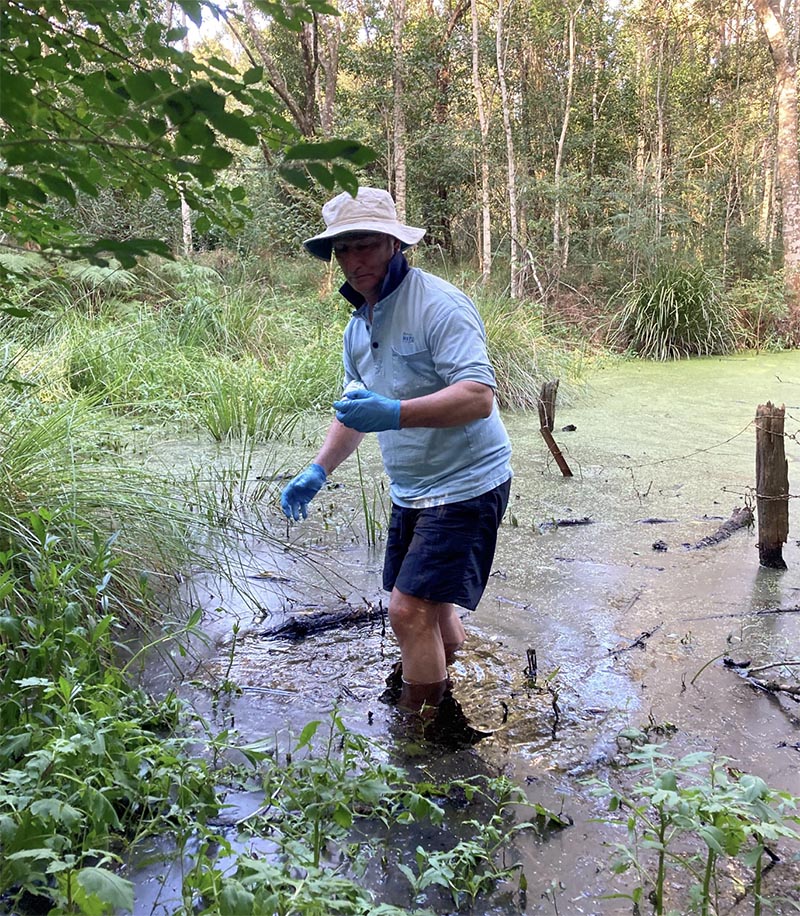
Associate Professor Dr Ian Wright taking water sample to test for PFAS.
9 September 2026
COMMUNITY representative Gary Chestnut said one of the most striking issues raised at the meeting was the difference between PFAS measured in water near the Ourimbah Creek weir and PFAS detected in a platypus found approximately 1.1 kilometres downstream.
“Council monitoring at Station 6 near the weir recorded PFAS at approximately 0.002 micrograms per litre, which is below the applicable Australian Drinking Water Guideline,” Mr Chestnut said.
“Associate Professor Dr Ian Wright then presented results that found a platypus downstream had approximately 740 micrograms of PFAS per kilogram of tissue.
“While these are different measurements, the concentration measured in the platypus tissue was an extraordinary 370,000 times higher than that measured in the water.
This does not prove the water at Station 6 caused the PFAS found in the platypus and it certainly does not mean that fish or yabbies in Ourimbah Creek are unsafe to eat.
“What it raises is a very obvious question about bioaccumulation.”
“Water samples provide a snapshot in time and place, while fish, yabbies, platypuses and other aquatic animals could be exposed over long periods through water, sediments and the food chain.
“Our first question is: what is accumulating in the fish and yabbies that people may catch and eat?”
The community welcomed information provided by the Member for Wyong and Minister for the Central Coast, the Hon. David Harris MP, that the NSW EPA’s 2025–26 Tuggerah Lakes PFAS ambient sampling program found all 19 monitoring locations below recreational and ecological water-quality guidelines.
“That is reassuring; however, water testing and tissue testing are not the same thing. The next logical step is to test the fish and yabbies and let the science tell us whether there is any reason for concern.”
Community representatives Gary Chestnut, Gaye Murrills and Zoe Wall have written to Mr Harris seeking NSW Government assistance with targeted fish and yabby testing.
Four Central Coast Councillors attended the community meeting. They are considering a Notice of Motion seeking an investigation of PFAS in Ourimbah Creek aquatic life, plus PFAS sediment testing within Mardi Dam.
Mr. Chestnut stressed that the community is not suggesting Mardi Dam or the Central Coast drinking-water is unsafe.
"Since the 1980's until recently, Ourimbah Creek was a primary source of drinking water for the old Wyong Shire which was pumped to Mardi Dam.
In 2000, large volumes of PFAS-containing firefighting foam were used to control a petrol tanker accident fire at the M1 Ourimbah Interchange near Ourimbah Creek. Water continued to be pumped from Ourimbah Creek into Mardi Dam until 2024 when Council found the pump had broken down. Dr. Ian Wright also informed Council of the presence of PFAS in Ourimbah Creek in
2024” Mr. Chestnut said.
“Given the extraordinary persistence of PFAS, our second question is whether PFAS may have been transported into Mardi Dam during those 24 years and, if so, whether any forever-chemicals have accumulated within the dam sediments.”
“This is not about creating alarm. If the testing shows there is nothing to worry about, that will be excellent news. If it identifies an issue, then the relevant authorities will have the evidence needed to respond.
“Our position is straightforward don’t assume there is a problem, but don’t assume there isn’t one either. Test it, publish the results and let the science provide the answer.”
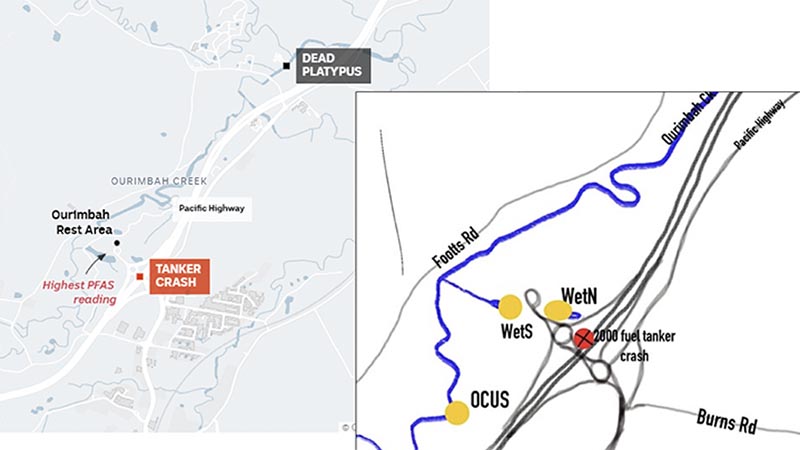
PFAS contamination sites (independent testing).
Background
PFAS (per- and polyfluoroalkyl substances) contamination in New South Wales creeks and drinking water catchments presents an ongoing challenge due to the extreme persistence and mobility of these synthetic "forever chemicals" in the environment.
The Ourimbah Creek catchment on the Central Coast of NSW has become a primary focal point for local PFAS contamination. Extensive investigation by environmental scientists and water authorities has revealed significant pollution in raw, untreated areas of the waterway.
Mangrove Mountain landfill, a dormant landfill Located at the top of the Ourimbah catchment, has been a key suspect in causing the pollution. Monthly testing by the Central Coast Council has consistently found elevated PFAS levels—particularly PFHxS and PFOS—in nearby upper catchment waterways. Some samples recorded PFHxS levels more than 58 times the national drinking water guidelines.
Water scientist Dr Ian Wright identified a wetland area near the Ourimbah Creek Rest Area as a major contamination hotspot. The suspected source is a catastrophic 40,000-litre petrol tanker crash on the M1 Motorway in December 2000. Emergency responders used roughly 1,000 litres of legacy, PFAS-heavy firefighting foam to extinguish the fire, which subsequently drained into the floodplain and local wetlands.
Independent testing discovered alarmingly high concentrations of PFOS in the livers of deceased platypuses recovered from Ourimbah Creek. Elevated levels have also been found in local Australian bass, causing concern for recreational fishers who use the creek.
While upper sub-catchments show high concentrations, downstream areas like Tuggerah Lakes (where Ourimbah Creek empties) have been tested by the EPA. Levels there remain safely below recreational water quality guidelines, meaning swimming and boating in the lake system remain safe.
Central Coast residents who live along Ourimbah Creek or use its waters, NSW Health strongly advises against using untreated creek or river water for drinking and cooking.



.jpg?crc=4257584689)


_web.jpg?crc=282450513)



SUBSCRIBE FOR FREE to the Grapevine News Online and to the monthly e-book edition of the Grapevine Community Weekly. Our online news platform and monthly newspaper is about real local news and events. We will not spam you or share your details with third parties.
