






Calls for data centre-free zone
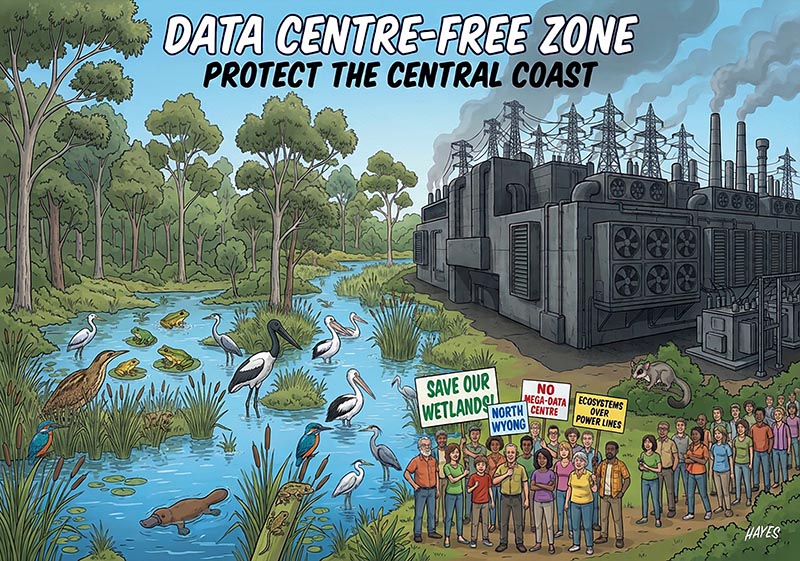
The Central Coast is facing a critical turning point. The first proposed data centre at North Wyong should set alarm bells ringing across our entire community and demand the immediate attention of all 15 Central Coast Councillors.
What is at stake is not simply one industrial development, but the future environmental, economic and social character of our region.
25 November 2026
WITH its staggering electricity demands, potentially serious environmental impacts, threats to sensitive bushland and waterways, additional pressure on essential infrastructure and comparatively few permanent jobs, this proposal raises a deeply troubling question: Why should Central Coast residents be expected to bear the long-term environmental and infrastructure costs of a development whose benefits to our community remain so uncertain?
The Community Environment Network (CEN) Chairperson Gary Chestnut is urging all 15 councillors to support making the Central Coast a Data Centre Free Zone, beginning with opposition to the Castle Group proposal at 30 Lucca Road and 1 Pavitt Crescent, North Wyong.
“The Central Coast should not become the dumping ground for Sydney's increasingly land-hungry and energy-intensive data centre industry,” Mr Chestnut said.
“We have spent decades protecting our natural environment and preserving employment land for industries that create genuine local jobs. The current proposal requires massive electricity consumption, with round-the-clock cooling equipment and more than 100 backup diesel generators, close to residential communities, schools and environmentally sensitive land.
“What does the Central Coast gain, and what price will our community and environment be expected to pay?”
Mr Chestnut said the proposed data centre's electricity requirements should immediately raise alarm bells. “The proposal identifies an IT load of approximately 96 megawatts, with total electricity demand potentially reaching 150 megawatts.
“Where will this electricity come from? What additional infrastructure will be required? And, most importantly, who will pay for it?
“At a time when households and businesses are struggling with rising electricity costs, the community deserves assurances that it will not subsidise infrastructure required by a highly energy-intensive private development.
“The NSW Government's own Data Centre Guidelines recognise the need for additional renewable energy generation and storage. Yet CEN has not identified binding renewable energy commitments in the publicly available scoping documents.”
CEN is also concerned about sacrificing strategically important industrial land for highly automated facilities that may generate relatively few permanent jobs. Data centres may generate substantial construction activity, but once operational their permanent employment requirements can be surprisingly modest,” Mr Chestnut said.
“Why should more than 12 hectares of valuable employment land be consumed by a development that may provide fewer ongoing jobs than alternative industrial uses? CEN has been unable to identify publicly available commitments from major tenants or anchor customers.
Mr Chestnut said the proposed site's flood exposure raised serious questions about its suitability.
“Is it sensible to locate critical electrical infrastructure, high-voltage equipment and substantial diesel fuel storage on flood-affected land?”
CEN is particularly concerned about the proximity of environmentally sensitive bushland, wildlife corridors, C3 Environmental Management land and the Porters Creek Wetland catchment, which forms part of the broader Tuggerah Lakes drainage system.
“Altered stormwater flows, industrial lighting, continuous mechanical noise and potential contaminated runoff all raise concerns for surrounding habitats and waterways.
“The proposal also raises bushfire management concerns, particularly where asset protection zones could require vegetation clearing near environmentally sensitive land.”
Mr Chestnut said the proposed air-cooled system may reduce water consumption, but it introduces other environmental concerns.
“Industrial cooling fans and associated equipment operating 24 hours a day, seven days a week, have the potential to generate persistent noise.
“Add the testing and emergency operation of more than 100 backup diesel generators, and there are legitimate concerns about noise and localised air pollution.
“Residential communities including Wadalba, Warnervale, Hamlyn Terrace, North Wyong and surrounding areas deserve proper protection.
“Families should not have to accept additional industrial noise, diesel emissions and intrusive lighting simply because a developer considers the location commercially attractive.”
Mr Chestnut said the proposal represented an important test of Council's commitment to responsible planning and environmental protection.
“This is not about opposing technology. It is about recognising that not every development belongs in every location.
“The Central Coast has limited industrial land, sensitive natural environments and growing residential communities. These are assets worth protecting.
“Our councillors have an opportunity to demonstrate genuine environmental leadership by putting the long-term interests of our community ahead of speculative, energy-intensive development.”
“The Central Coast is far too valuable to become an overflow industrial estate for Sydney's data centre expansion.
“Protect our environment, protect our communities and protect our future. Keep the Central Coast free of large-scale data centres.”







SUBSCRIBE FOR FREE to the Grapevine News Online and to the monthly e-book edition of the Grapevine Community Weekly. Our online news platform and monthly newspaper is about real local news and events. We will not spam you or share your details with third parties.
