





A behemoth for the Central Coast
A massive corporate scramble to build Artificial Intelligence (AI) and cloud infrastructure has arrived on the Central Coast, bringing with it a fierce battle over the region’s fundamental resources.
A controversial $1.5 billion data centre proposed for 30 Lucca Road and 1 Pavitt Crescent in North Wyong has moved to its initial regulatory milestone with the NSW Department of Planning. But while the developer, DCG Admin, pitches the 96-megawatt (MW) facility as a triumph for the state’s digital economy, an escalating chorus of local advocates, environmental scientists, and community groups are warning of an impending ecological and economic disaster.
21 October 2026
ALAN HAYES
THE emerging battle lines reveal that the proposed facility’s glossy promises of digital progress mask an unsustainable appetite for the Central Coast's most vulnerable resources: drinking water and the fragile electrical grid. Behind closed doors, a critical flashpoint has emerged. Despite initial corporate statements championing a "dry air-cooled" design, investigators and community advocates warn that the sheer thermodynamic scale of the facility has proponents looking to secure access to existing water licences in the Central Coast’s primary water catchment district. One local water licence holder spoke to the Grapevine and revealed that they had been approached by a data centre company keen to secure the rights of their water licence.
A direct threat to the water catchment district
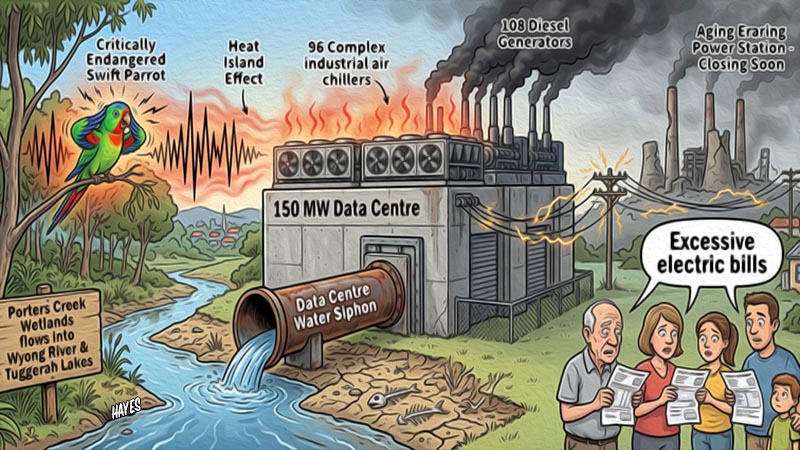
To keep thousands of high-density server racks from melting under the intense computational loads required by modern AI algorithms, data centres require absolute, unrelenting thermal regulation. While the developer's public-facing scoping documents highlight a rooftop array of 96 dry air-cooled chillers, experts note that extreme Australian summer temperatures often force mega-facilities to rely on evaporative water backup systems to prevent critical hardware failure.
Local environmental groups have sounded the alarm over indications that proponents are quietly seeking baseline contingencies to draw directly from the Central Coast's major water catchment district. This vital environmental sanctuary was formally legislated and protected in 1950 to secure the post-war survival and agricultural viability of the region.
Today, this single, delicate network of rivers, pumping stations, and dams provides a staggering 85% of the region’s entire domestic drinking water supply.
"Any attempt to tap into the 1950 legislated catchment is an absolute line in the sand," says a representative from a local water preservation action group. "This catchment was created by law to safeguard human life and regional agriculture, not to be evaporated into steam to cool down server farms processing global internet traffic. Siphoning potable water from an ecosystem that sustains nearly 350,000 residents is a dangerous gamble, especially as we face increasingly volatile climate cycles".
The scale of water consumption by the data centre industry is increasingly coming under intense federal scrutiny. Recent warnings issued by the Department of the Prime Minister and Cabinet reveal that within a decade, power-hungry AI infrastructure could consume up to 20% of Sydney’s water supply. If the Wyong project is granted access to local pristine flows, the Central Coast could find its domestic water security severely compromised during periods of prolonged drought, forcing residents into strict water restrictions while corporate servers drink freely.
Fossil fuels and an aging power grid
Equally alarming is the sheer volume of electricity required to keep the Lucca Road facility running 24 hours a day, 7 days a week. The proposed site targets an IT load capacity of 96 MW, but its total draw from the grid is expected to reach up to 150 MW to power infrastructure, switchyards, and secondary operations.
At a time when New South Wales is desperately trying to transition away from carbon-heavy energy, the introduction of a 150 MW continuous energy sink will force an unacceptable level of additional fossil fuel burning. Because Australia’s National Electricity Market (NEM) still relies heavily on coal and gas to supply base-load power, the data centre will effectively act as a massive carbon emitter by proxy. Critics point out that the daily energy consumption of this single building will rival that of tens of thousands of average domestic homes, wiping out local gains made through residential solar and emission-reduction programs.
Making matters worse, the Central Coast's aging electrical grid is fundamentally incapable of safely absorbing this massive, concentrated load. The facility is designed to connect directly to the Ausgrid 132kV Wyong Zone Substation. However, engineers familiar with the local network warn that the regional infrastructure is already severely fatigued.
The crisis is compounded by the status of the region's Eraring and Vales Point power stations, which are rapidly approaching their mandatory end-of-life target. With primary coal-fired assets slated for imminent decommissioning and closure over the coming years, the state's energy supply is entering its tightest bottleneck in half a century. The aging grid simply does not possess the surplus capacity to feed a 150 MW industrial parasite without risking localised system instability, voltage sags, and catastrophic blackouts during peak summer periods.
To counteract potential grid failures, the developer’s current blueprint includes installing a staggering 108 backup diesel generators, supported by 1,430 kilolitres of on-site diesel storage. Far from reassuring the community, this has provoked intense backlash. Residents point out that testing and running over a hundred heavy-duty industrial generators will unleash toxic particulate matter and an unacceptable level of noise pollution directly into the North Wyong airspace.
The hidden cost: skyrocketing household power bills
For everyday families living across Wyong, Warnervale, and the broader Central Coast, the most immediate consequence of the Lucca Road proposal will likely be felt directly in their wallets. Energy market analysts have repeatedly warned that the rapid, unregulated influx of hyper-scale data centres across Australia is directly driving up wholesale electricity costs.
Because data centres operate around the clock, they buy up immense blocks of base-load electricity through rigid, long-term corporate power purchase agreements. This drastically reduces the volume of cheap power available on the open market. When the grid is strained—such as on a 40-degree January afternoon—the limited remaining electricity supply triggers extreme price spikes on the wholesale market.
As a direct result, retail electricity providers are forced to pass these soaring costs directly down the line. Central Coast residents are facing the very real likelihood of drastically increased energy charges for domestic electricity supply. Local households, many already buckling under persistent cost-of-living pressures, will effectively be forced to subsidise the immense electrical bills of multi-billion-dollar technology conglomerates.
"Our power bills are already out of control," wrote a frustrated resident on a prominent Central Coast Community Forum. "We are being told to turn off our air conditioners to save the grid, while a massive foreign-backed server farm is allowed to come into Wyong, chew up our electricity, drive up our domestic tariffs, and give nothing back to the community except a handful of security guard and maintenance jobs".
Cost to the environment
In addition to the immediate strain on water and energy infrastructure, the Lucca Road facility poses a severe threat to the fragile local ecosystems surrounding North Wyong. The proposed site borders the lower floodplain of Porters Creek Wetland, the largest remaining freshwater wetland on the Central Coast. This vital ecological reserve acts as a natural filter for the region's waterways and serves as a critical habitat for threatened flora and fauna, including the endangered Swift Parrot and various migratory wetland birds.
The massive physical footprint of the data centre requires covering acres of permeable land with concrete, heavily accelerating stormwater runoff. Environmental scientists warn that during heavy rain events, this rapid runoff will carry industrial pollutants, automotive oils, and urban residue straight into the Porters Creek catchment. Despite the developer's plans for localised levee bund extensions, altering the natural floodplain dynamics risks disrupting the delicate hydrological balance of the wetlands, leading to erosion and the destruction of sensitive breeding grounds.
Furthermore, the facility's heavy reliance on 96 massive rooftop air-cooled chillers introduces the insidious threat of thermal pollution and localised microclimate disruption. Operating non-stop, these industrial cooling systems inject immense amounts of concentrated heat directly into the ambient atmosphere. This constant thermal plume can elevate local temperatures, creating a localised "heat island" effect that stresses surrounding vegetation and alters the behavioural patterns of nocturnal wildlife. Combined with the low-frequency hum and vibrations emitted by around-the-clock server operations and mandatory testing of the 108 diesel generators, the surrounding peaceful ecosystem faces permanent acoustic and environmental degradation.
A growing political and community backlash
The compounding environmental and economic threats of the Lucca Road proposal have turned the project into a political lightning rod. The Central Coast Greens have launched a highly visible campaign calling for an immediate, legally binding moratorium on all AI data centre developments across the region. They argue that the current planning framework treats these massive digital factories with less scrutiny than a residential granny flat, leaving local councils entirely unequipped to protect their electorate's natural resources.
Furthermore, community groups argue that the economic justification for the project is fundamentally flawed. While standard industrial developments, like manufacturing hubs or distribution centres create hundreds of permanent, localised jobs for the community, data centres are almost entirely automated after their initial construction phase. Once the concrete is poured and the servers are bolted into their racks, a 96 MW facility can be operated by fewer than 30 or 40 technical staff on shift.
"This is classic environmental injustice," says an organiser from a Wyong resident action group. "They'll take our water supply, they'll overload our failing electricity grid, they'll burn more coal to keep their tech running, and they'll make our household power bills go up. In return, the Central Coast gets practically zero long-term employment, severe noise pollution from 108 diesel generators, and the risk of dry taps".
The road ahead for the SSD application
Because the project has been designated as a State Significant Development (SSD-148199991), the ultimate power to approve or reject the Lucca Road facility bypasses the local Central Coast Council entirely, placing the decision squarely in the hands of the NSW Minister for Planning.
The project is currently locked in the "Prepare SEARs" stage, meaning the NSW government is compiling the strict environmental, structural, and civil criteria that the developer must legally address before the proposal can progress. Armed with historic legislative precedents like the 1950 water catchment declarations, local advocacy groups will begin actively lobbying state independent MPs and planning officials to ensure that this project should be rejected.
As the corporate digital gold rush collides head-on with regional resource limits, the Lucca Road proposal has become a crucial test case for the state. The coming months will reveal whether the NSW Government will prioritise the unyielding infrastructure demands of big tech, or protect the vital drinking water, power grid, and financial survival of the people of the Central Coast.
Not to protect the Central Coast from this looming behemoth is a risky move for the Minns State Government, particularly with an election early next year.






SUBSCRIBE FOR FREE to the Grapevine News Online and to the monthly e-book edition of the Grapevine Community Weekly. Our online news platform and monthly newspaper is about real local news and events. We will not spam you or share your details with third parties.
